Bangladesh's E-Waste Could Be Worth $200 Million a Year: Almost Nobody Is Recycling It
Bangladesh throws away roughly 3 million tonnes of electronic waste every year, and researchers say the recoverable metals inside it are worth 200 to 221 million US dollars annually. Less than a tenth of it is formally recycled, and government records show zero tonnes were collected by registered recyclers last fiscal year. For a handful of small waste-management startups already working the problem, that gap is either a crisis or the biggest opportunity nobody has claimed yet.
Every year, Bangladeshi households and businesses throw out somewhere around 3 million tonnes of electronics, dead mobile phones, burnt-out computers, retired air conditioners, discarded wiring, and batteries that have stopped holding a charge. Buried inside that pile, according to research presented by Voices for Interactive Choice and Empowerment, known as VOICE, and the Association for Progressive Communications, is somewhere between 200 million and 221 million US dollars worth of recoverable copper, aluminium, and other metals, every single year. Less than 10 percent of it is formally recycled. According to government data cited in the research, registered recycling entities collected zero tonnes of e-waste in the last fiscal year.
That is not a typo, and it is not for lack of e-waste being generated. It is a description of an entire economic sector that exists almost entirely outside the formal system, run instead by an informal network of scrap collectors, roadside dismantlers, and small workshops that strip old electronics for whatever metal they can pull out by hand, often using methods, such as open burning of cables to recover copper, that release toxic fumes with little regard for worker safety or environmental harm.
Musharrat Mahera, deputy director at VOICE, framed the recoverable value plainly in the research: the country is sitting on an asset worth up to nine figures every year and treating almost all of it as garbage. Zakir Hossain Khan, chief executive of Change Initiative, has been among those pushing for Bangladesh to adopt a genuine circular economy approach to electronics, one where a phone or a laptop is designed, collected, and processed with its end-of-life value built into the plan from the start rather than left to whoever happens to pick through the trash afterward.
For entrepreneurs, this is precisely the kind of gap that tends to attract attention, a large, quantified market failure with almost no organised competition in it yet. A small number of formal players have already staked out early positions. Pro Recycling Ltd, a Gazipur-based waste management company founded around 2017, has built out operations that its own figures put at roughly 120 tonnes of waste processed, using a network of collection containers and a team that the company describes as around two dozen people. Other formal operators, including JSM Recycling and a handful of smaller outfits, occupy similar territory, handling computer scrap, telecom equipment, and battery waste for corporate clients who need documented, compliant disposal.
Set those numbers against the scale of the problem and the gap becomes stark. If Pro Recycling's reported 120 tonnes represents something close to a leading formal operator's annual volume, and the country generates roughly 3 million tonnes of e-waste a year, the arithmetic suggests formal recyclers are collectively touching a vanishingly small fraction of the total stream, even before accounting for the fact that several such companies operate simultaneously. That mismatch, a nine-figure dollar opportunity against a handful of small operators each processing a few dozen or a few hundred tonnes, is exactly the kind of structural gap that has drawn entrepreneurs into other underserved sectors of the Bangladeshi economy in recent years, from mobile financial services to e-commerce logistics.
The barriers explaining why the gap has persisted are not mysterious, and researchers have been fairly direct about naming them. Dr Rowshan Mamtaz, a professor at the Bangladesh University of Engineering and Technology, has pointed to the absence of strategic, coordinated waste management systems as a core structural problem, not merely a matter of individual companies failing to scale. Tarit Kanti Biswas, a consultant with the health directorate, has emphasised that Bangladesh still lacks reliable primary data on how much e-waste different regions and sectors actually generate, which makes it difficult for either policymakers or investors to size the opportunity with real confidence beyond broad national estimates. Ahmed Swapan Mahmud, VOICE's executive director, has called for clearer institutional frameworks, meaning defined rules for collection, processing standards, and accountability, without which formal recyclers struggle to compete on cost with an informal sector that carries none of the compliance overhead.
That regulatory vacuum cuts both ways for anyone thinking about entering the space. On one hand, the absence of a well-defined licensing and collection framework means a new entrant faces real uncertainty about the rules of the game and can expect to compete against an informal sector with structurally lower costs, since roadside dismantlers pay no environmental compliance costs and often no taxes on the scrap trade. On the other hand, that same vacuum means there is no dominant formal player commanding the market yet, no incumbent moat, no requirement to unseat an established brand, just an enormous, well-documented resource stream waiting for someone to build the collection logistics and processing capacity to capture it at scale.
The path that has worked in other e-waste markets globally typically starts narrow rather than broad: a startup picks one high-value, relatively homogeneous waste stream, corporate IT equipment, for instance, or retired telecom infrastructure, rather than trying to collect everything from household batteries to industrial machinery on day one. Corporate clients tend to value documented, compliant disposal for their own regulatory and reputational reasons, which can support better margins than competing directly with informal scrap collectors for household electronics. Several of Bangladesh's existing formal recyclers appear to have followed something close to this model already, building relationships with corporate and institutional clients before attempting to compete for the much larger, more fragmented household waste stream.
None of this means the informal sector should be treated simply as an obstacle to be swept aside. Tens of thousands of people in Bangladesh currently earn some or all of their livelihood from scrap collection and informal dismantling, work that is often dangerous and poorly paid but that nonetheless supports real households. Researchers pushing for a more formal e-waste system have generally framed the goal as integration rather than elimination, bringing existing informal collectors into safer, better-paid roles within a formal supply chain rather than displacing them outright, a pattern that has played out with mixed success in other countries that have formalised their own scrap and recycling economies. Any startup or policy intervention that ignores this workforce, rather than designing around it, is likely to face resistance that a purely technical or financial pitch will not overcome.
Whether a venture-backed, technology-enabled player eventually enters Bangladesh's e-waste sector at meaningful scale, doing for electronics recycling something like what ride-hailing and mobile banking did for their respective sectors, remains an open question. The ingredients that typically attract growth capital, a large addressable market, a clear economic inefficiency, and early operators proving the basic model works, all appear to be present. What is missing, according to the researchers who have studied the sector most closely, is the institutional scaffolding, clear collection standards, defined processing rules, and enforcement against the most harmful informal practices, that would let a formal operator scale up faster than the informal sector can simply absorb more volume through its existing, uncounted channels.
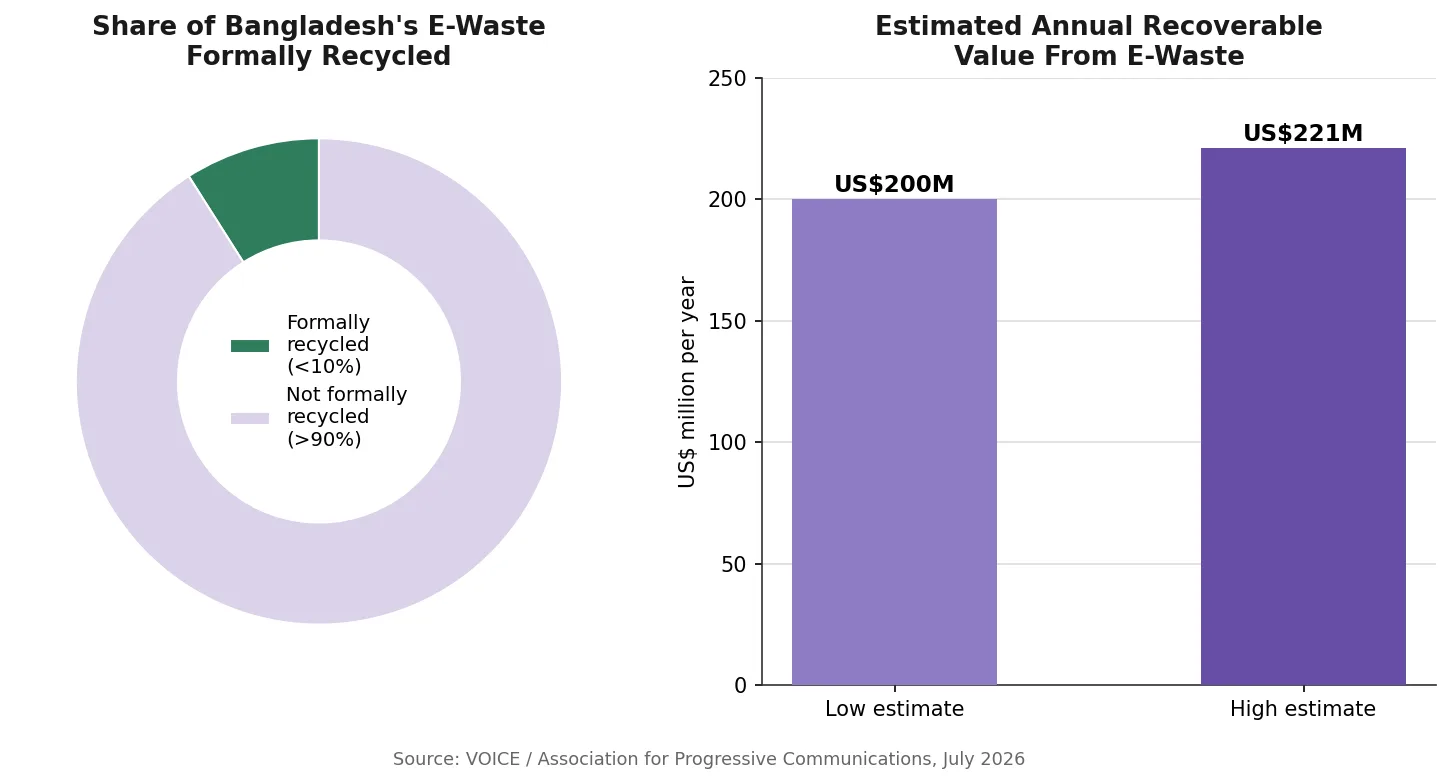
Bangladesh's formal e-waste recycling rate and estimated annual recoverable value. Source: VOICE / APC, July 2026.
References
Free calculators
All calculatorsEMI & loan calculator
Monthly installment, total interest and a full repayment schedule. Compare two loan offers side by side.
Zakat calculator
Work out your nisab status and the 2.5% zakat due on cash, gold, silver, savings and business assets.
FDR & DPS maturity calculator
Maturity amount for a fixed deposit or monthly deposit scheme, after compounding and source tax.
Read next

Why Your Shop's Trade Licence Now Depends on Showing a Bangla QR Code
Getting or renewing a trade licence in Bangladesh now comes with an extra step: showing you accept Bangla QR payments. The Local Government Division has instructed city corporations, municipalities and district administrations to make Bangla QR integration a condition of licensing, and this month it told them to start enforcing it in the field. The rule builds on a year of escalating central bank mandates, backed by fines up to Tk30 lakh and jail time for banks and payment providers that don't comply.

Bangla QR Payments Go Free and Instant From Today as Bangladesh Bank Picks Up the Tab
Bangladesh Bank confirmed on September 30 that starting October 1, every Bangla QR merchant payment is credited instantly, with the minimum 1 percent merchant discount rate scrapped and the interchange fee set to zero, letting banks offer the service free or at nominal cost. The central bank will cover the gap with its own incentives of up to Tk2,000 per transaction, a bet on a network that has already grown 3.5 times in transaction volume over the past 90 days. Person-to-person transfers get the same instant treatment from November 1, and banks have until October 31 to fix several usability gaps in how customers access the service.

Startup Funding in Bangladesh Falls to a Five Year Low as a New Tk400 Crore Government Fund Tries to Fill the Gap
Bangladesh's startups raised just $6 million in the first half of this year, a 95 percent collapse from the $120 million raised in the same months of 2025, even as global venture capital nearly doubled over the same stretch. The government's answer, a Tk400 crore Fund of Funds run through Startup Bangladesh Limited, began accepting expressions of interest from venture capital firms in August, aiming to route public money into the private funds startups actually deal with day to day. Founders and industry figures blame a familiar mix of dollar shortages, scattered regulation across multiple agencies and thin exit options, problems a single government fund is unlikely to solve on its own. Whether Tk400 crore can meaningfully offset a $114 million shortfall in private funding is the real question hanging over the program.