Bangladesh Gold Price Bounces Back Tk1,050 a Bhori After Three Straight Cuts

Bangladesh's gold market snapped a three day losing streak this week after the Bangladesh Jewellers Association raised the price of 22 carat gold by Tk1,050 to Tk232,930 a bhori, tracking a rise in raw tejabi gold on the local market. The move is the 115th price adjustment Bajus has made so far in 2026, split almost evenly between increases and cuts, a pace that has left buyers and jewellers struggling to plan around a metal Bangladeshis have long treated as a stable store of value. Globally, spot gold has been swinging between a scorching August rally and a bumpy September as traders weigh a possible Federal Reserve rate move against persistent inflation and Middle East tensions. For ordinary households, the swings mean gold has become almost as hard to plan around as the currency it is meant to hedge against.
Gold Reverses Course After a Rough Week
Bangladesh's gold market snapped a three day losing streak on September 12, when the Bangladesh Jewellers Association, known locally as Bajus, raised the price of 22 carat hallmarked gold by Tk1,050 to Tk232,930 per bhori. The increase, effective from 10am that day, followed a sharper Tk2,158 cut just a day earlier that had pushed the price down to Tk231,880. Bajus attributed the reversal to "the overall market situation following a rise in the price of pure gold, known locally as tejabi gold, in the local market," a phrase the association uses whenever it is following rather than leading the price cycle.
The other grades moved in step. Twenty one carat gold now sells for Tk222,491 a bhori, eighteen carat for Tk191,056, and the more affordable traditional or sanatan grade for Tk156,064, all figures inclusive of value added tax. Silver held steady through the adjustment, with 22 carat silver unchanged at Tk5,016 a bhori, 21 carat at Tk4,782, 18 carat at Tk4,082 and sanatan grade at Tk3,091.
A Year of Near Constant Repricing
What makes this particular Tk1,050 increase notable is not its size but its place in a much longer pattern. Bajus has now adjusted gold prices 115 times so far in 2026, splitting almost evenly between 57 increases and 57 decreases, plus a single VAT related adjustment. Silver has seen 69 separate changes over the same stretch, 35 increases against 34 decreases. For a market that traditionally repriced gold only a handful of times a month, that works out to nearly one adjustment every two days, a pace that has left jewellers and buyers alike struggling to plan around the metal that Bangladeshi households have long treated as a stable store of value.
BD Financial Review's own tracking of the market over the past two weeks shows just how choppy the ride has been. Gold stood at Tk234,038 a bhori on September 9, itself a cut from levels seen earlier in the month. It fell further to Tk231,880 by September 11, only to bounce back up to Tk232,930 the next day. Zoom out further and the swings get even more dramatic: across August alone, the 22 carat rate moved from roughly Tk223,000 to as high as Tk248,000 a bhori, a rollercoaster of nearly Tk25,000 in a single month, before easing back into the low Tk230,000s heading into September. A trader in Dhaka's Bailey Road gold market, describing the period a few weeks ago, said customers had started asking for daily price sheets before deciding whether to buy or sell, something that was rarely necessary before this year.
| Date | 22 Carat Price (Tk/bhori) | Change |
|---|---|---|
| September 9 | 234,038 | -1,108 |
| September 11 | 231,880 | -2,158 |
| September 12 | 232,930 | +1,050 |
Why the Global Market Keeps Whipsawing Local Prices
Bangladesh sets its gold prices as a function of the international bullion market plus import costs and duties, so the local repricing frenzy is really a mirror of a genuinely unsettled moment for gold worldwide. Spot gold was trading around 4,358 dollars an ounce as of September 10, having slipped more than 1 percent that day alone, yet the metal still finished August up roughly 13 percent, one of its strongest single month performances in 25 years. That kind of run up followed by a wobble is exactly the pattern that has been showing up in Bajus's own price sheet.
The forces pulling gold in different directions are unusually evenly matched right now. On one side, Brent crude has climbed to around 105 dollars a barrel on fears over shipping and energy supply disruptions, and an escalating Middle East conflict has kept safe haven demand elevated. Investors have piled into gold backed exchange traded funds accordingly, with roughly 18 billion dollars of inflows in August alone pushing global ETF holdings to a record 4,189 tonnes. On the other side, hotter than expected inflation data out of the United States, including a 0.4 percent monthly rise in producer prices, has traders now pricing in around a 70 percent chance of a Federal Reserve move at its September 15 and 16 meeting, up from 62 percent before the data. Higher rates and a firmer dollar tend to make non yielding gold less attractive, which is the headwind analysts point to whenever they explain why a rally like August's does not simply continue in a straight line. One market analyst summed up the tension by noting that higher real interest rates and a stronger dollar are likely to remain near term headwinds for gold, even as its role as a portfolio diversifier keeps demand from disappearing entirely.
How Bajus Actually Sets the Price
Unlike a stock exchange with continuous trading, Bangladesh's gold market runs on a committee model. Bajus tracks the price of raw, unworked gold, referred to locally as tejabi gold, in Dhaka's wholesale bullion market, which itself moves in line with the international rate converted through the interbank dollar exchange rate plus import duty and a small margin for refining and assay. When tejabi gold moves meaningfully in either direction, typically by more than a few hundred taka per bhori, Bajus convenes and issues a fresh notice for hallmarked retail gold, effective from a set hour the same or next day. That structure is precisely why local prices can lag the global market by a day or two and then catch up in a single sharp jump, rather than drifting smoothly the way a continuously traded asset would.
The system also means Bangladesh's gold price swings are somewhat amplified compared with neighbouring markets. India, for instance, allows far more granular daily and even intraday movement across thousands of individual jewellers referencing live bullion rates, which tends to spread small changes out rather than bunching them into large, discrete jumps. Bangladeshi jewellers have periodically called for a similar shift toward more frequent, smaller adjustments, arguing it would be easier on both retailers holding inventory and consumers trying to time purchases, but Bajus has so far kept its notice based system intact.
What It Means for Bangladeshi Buyers
For ordinary consumers, the practical upshot is that gold has stopped behaving like the slow moving asset it used to be. Wedding season buyers, who account for a large share of retail gold demand in Bangladesh, are increasingly timing purchases around Bajus's daily notices rather than assuming prices will hold steady for a week or two. Jewellers, for their part, say the constant repricing complicates inventory planning, since stock bought at one price can be worth meaningfully more or less by the time it reaches a showroom counter.
The coming days could bring more movement rather than less. With the Federal Reserve's September policy decision due within a week and geopolitical risk premiums still elevated in oil markets, Bajus is unlikely to have made its last adjustment of the month. For now, Tuesday's Tk1,050 increase is a modest correction rather than a trend reversal, but it is a reminder that in 2026, gold in Bangladesh has become a market that moves almost as often as it is watched.
References
Read next

Gold Price Falls Again in Bangladesh, 22 Carat Now 234,038 Taka a Bhori
Bajus cut the price of 22 carat hallmarked gold by 1,108 taka to 234,038 taka per bhori on Tuesday, the second reduction in three trading days after a volatile stretch that saw prices swing by thousands of taka within a week. The metal has now been repriced 111 times so far this year as local rates track a choppy international bullion market. Silver moved in step with gold through the same period.
Third Cut in a Week: 22-Karat Gold Falls Again to Tk 2,31,880 as Bajus Tracks the Global Slide
Bangladesh's jewellers cut gold prices for the third time in five days on September 2, pulling 22-karat gold down to Tk 2,31,880 per bhori. The Bangladesh Jewellers Association points to falling prices in the international bullion market, and the new rate has held steady into September 3. Silver prices eased too, though far more modestly.
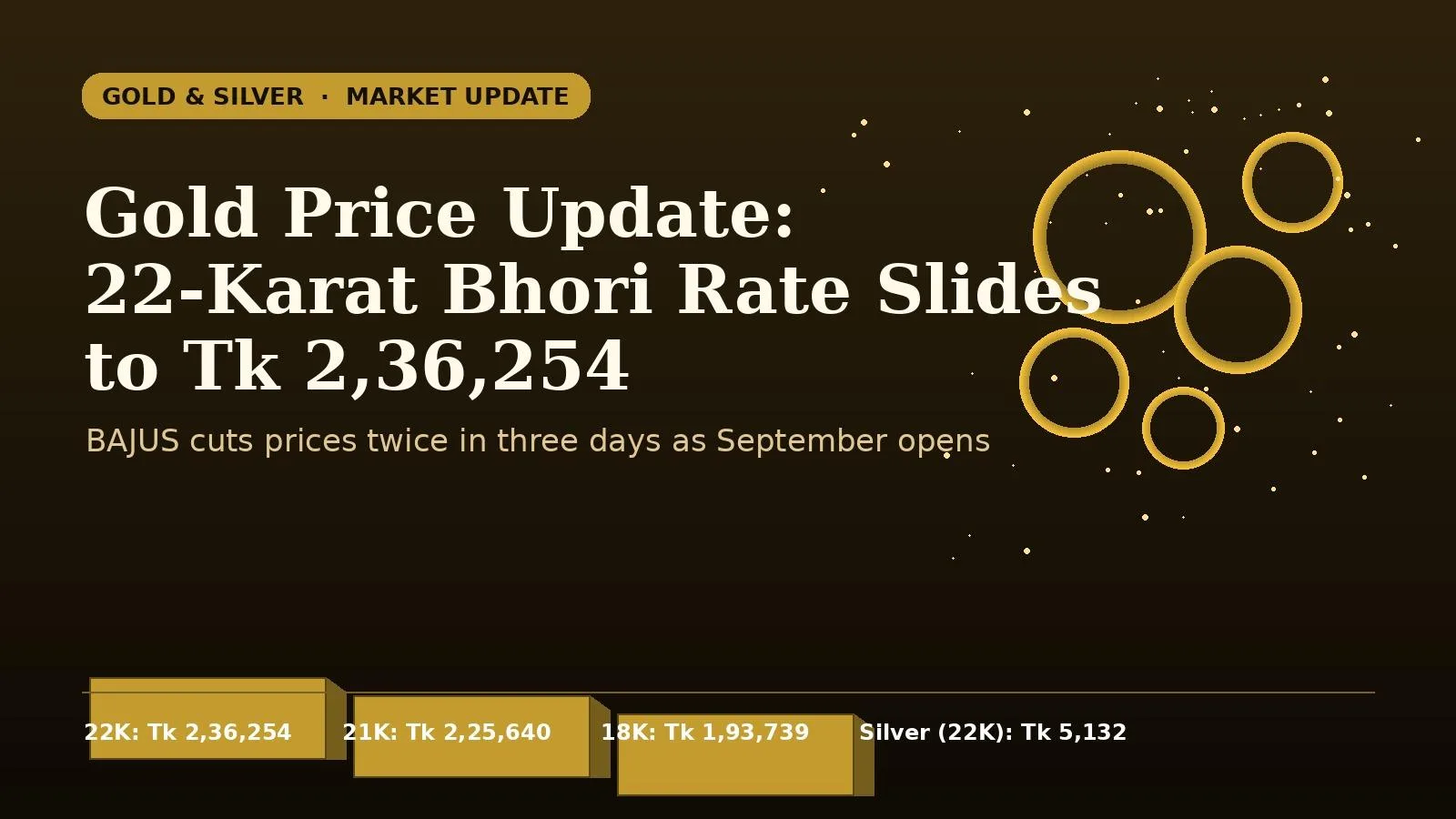
Gold Price Update: 22-Karat Rate Falls to Tk 2,36,254 as BAJUS Cuts Twice in Three Days
Bangladesh's gold market has cooled since August's wild price swings. BAJUS slashed 22-karat gold prices twice in three days, on August 29 and August 31, pulling the bhori rate down by a combined Tk 11,489. As of September 2, the new lower price is holding steady and silver has eased too. Here is what changed since our last report, and what it means if you are buying jewellery this month.