Gold Price Update: 22-Karat Rate Falls to Tk 2,36,254 as BAJUS Cuts Twice in Three Days
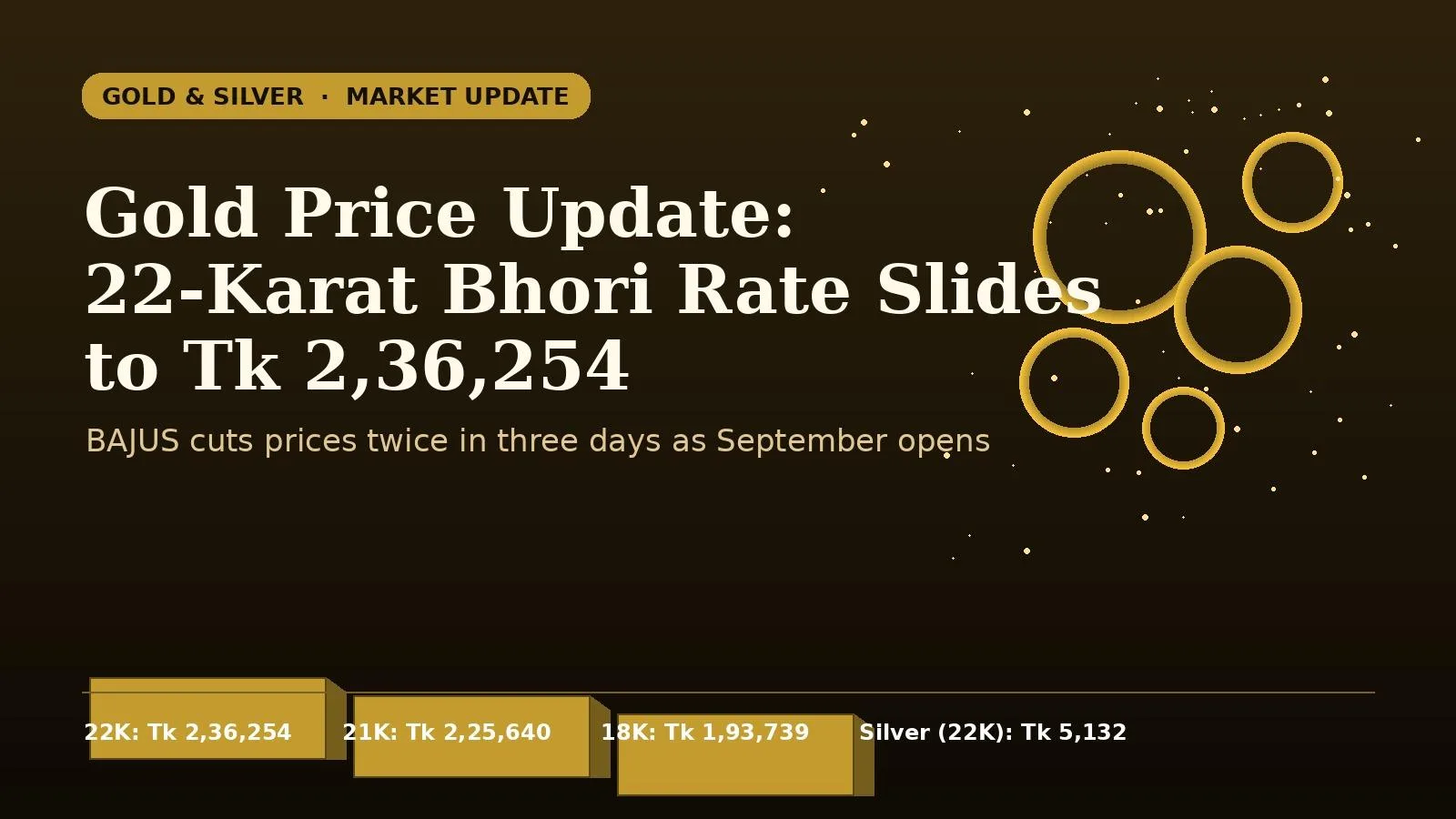
Bangladesh's gold market has cooled since August's wild price swings. BAJUS slashed 22-karat gold prices twice in three days, on August 29 and August 31, pulling the bhori rate down by a combined Tk 11,489. As of September 2, the new lower price is holding steady and silver has eased too. Here is what changed since our last report, and what it means if you are buying jewellery this month.
Bangladesh's gold market has finally found a moment of calm, even if it is calm at a lower altitude. Just days after this website reported on August's dramatic bhori price swings, the Bangladesh Jewellers Association (BAJUS) cut the price of 22-karat gold twice in three days, taking a combined Tk 11,489 off the bhori rate. That new, lower price has now held steady for two straight days heading into September, giving buyers something August rarely offered: a stretch of predictability. Here is what has actually changed since our last update, where gold price in Bangladesh stands today, September 2, and what it means if you are thinking about buying gold or silver jewellery this month.
Two cuts in three days: how BAJUS got here
According to The Business Standard, BAJUS moved twice in quick succession. On August 29, the association cut the price of 22-karat gold by Tk 7,115 per bhori. Two days later, on August 31, it cut prices again, this time by Tk 4,374 per bhori. Add the two rounds together and jewellers shaved Tk 11,489 off the 22-karat rate in less than a week. That is a meaningful move in a market that, only weeks earlier, had been the story for entirely the opposite reason, when the 22-karat bhori rate swung as high as roughly Tk 2.48 lakh during August before easing back toward Tk 2.41 lakh by month's end.
Working backward from the confirmed post-cut figure, the 22-karat bhori rate stood at approximately Tk 2,47,743 just before the August 29 cut. After the first reduction it fell to around Tk 2,40,628, and after the second cut on August 31 it settled at Tk 2,36,254, where it remains as of September 2. In other words, gold price in Bangladesh has not just paused since our last report, it has continued sliding, only now in a more orderly, two-step fashion rather than the choppier swings seen earlier in August.
Where 22 carat gold price per bhori stands today
As of 10am on August 31, and still holding as of September 2 according to live pricing tracked by Probashir Diganta, BAJUS-set rates for gold in Bangladesh, all inclusive of VAT, are:
22-karat gold: Tk 2,36,254 per bhori
21-karat gold: Tk 2,25,640 per bhori
18-karat gold: Tk 1,93,739 per bhori
Traditional gold: Tk 1,58,280 per bhori
For readers who think in grams rather than bhori (one bhori equals 11.664 grams), the per-gram equivalents work out to roughly Tk 20,258 for 22-karat, Tk 19,353 for 21-karat, Tk 16,619 for 18-karat, and Tk 13,577 for traditional gold. The fact that these numbers have not moved between the August 31 cut and September 2 is itself the news here: after a month defined by volatility, the market has effectively parked at this level for two to three days, which is as close to stability as gold price Bangladesh today has managed in recent weeks.
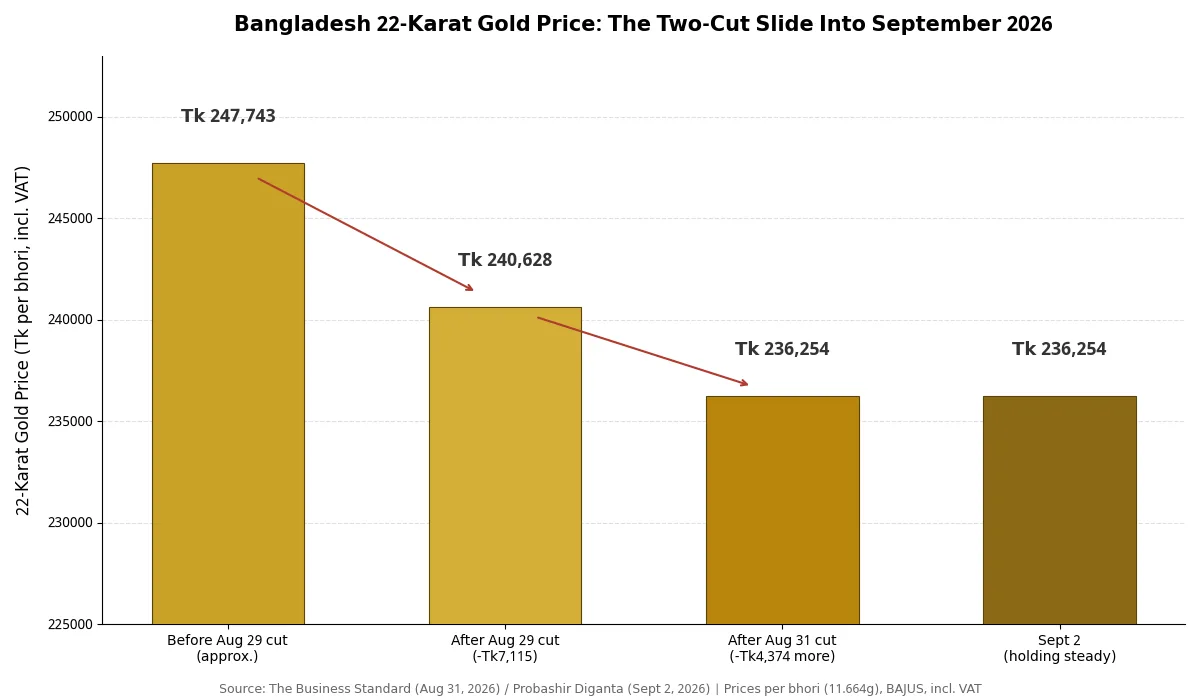
22-karat gold price trend: from the pre-cut level through both BAJUS reductions to the Sept 2 rate.
Why did gold get cheaper
BAJUS's own explanation was brief. The association attributed both rounds of cuts to "a fall in the price of tejabi (pure) gold in the local market." Tejabi gold refers to the refined, near-pure bullion that jewellers use as their raw material benchmark before factoring in making charges and karat-specific pricing, so when tejabi softens, the retail bhori rates for 22-karat, 21-karat and 18-karat jewellery tend to follow it down. What BAJUS did not spell out is the deeper cause, whether that is movement in the international gold price, a stronger taka, softer local demand, or some mix of the three. For now, jewellers and buyers alike are working off the same short explanation, and there has been no fresh BAJUS statement since August 31 to update it.
Silver slips too, but mind which price you are reading
Silver price in Bangladesh moved lower as well, though anyone comparing numbers needs to be careful, because two very different pricing conventions are circulating right now. On the retail side, BAJUS's 22-karat silver ornament price dropped by Tk 175 to Tk 5,132 per bhori as of August 31, alongside the gold cuts. That is the number that matters if you are walking into a jewellery shop to buy a silver bangle or chain.
Separately, live bullion tracking from livepriceofgold.com, checked on September 2, put fine 999 silver at roughly Tk 251 per gram, about Tk 7,807 per troy ounce, and around Tk 2,928 per tola. This is a spot-market, investment-grade figure tied to global silver prices, which were trading in a range of roughly $63.41 to $64.33 an ounce internationally and were down about 0.77 percent on the day. These two silver prices, the BAJUS retail ornament rate and the fine bullion spot rate, are not measuring the same thing and should never be quoted interchangeably. One reflects finished 22-karat silver jewellery at a local shop counter; the other reflects a purer bullion benchmark priced off the international market. Both, however, point the same direction this week: silver price Bangladesh has eased alongside gold.
What the lower price means if you are buying
For anyone who held off buying jewellery during August's peak, the current environment is arguably a better entry point than it has been in weeks. At the height of August's swings, the 22-karat bhori rate touched roughly Tk 2.48 lakh; today it sits at Tk 2,36,254, a difference of well over Tk 10,000 per bhori. That is not a small gap if you are budgeting for a set of wedding jewellery or a modest gold savings purchase. Whether this counts as a genuine floor or simply a pause before the next move is impossible to say with certainty, since BAJUS has not indicated where tejabi gold prices are headed next, but for now the trend since our last report has been consistently downward rather than back up toward August's highs.
Silver buyers get a similar, smaller benefit: a Tk 175 per bhori reduction is modest, but combined with a softer global spot silver price, it suggests the metal is not swimming against the tide either.
The VAT and making-charge note buyers often skip
One detail worth repeating every time BAJUS publishes a new rate: the quoted bhori prices above already include VAT on the value of the gold itself. But that is not the full amount you will pay at the counter for an actual piece of jewellery. Buyers should budget for an additional 5 percent VAT along with a minimum making charge of around Tk 3,500 per bhori, layered on top of the quoted BAJUS rate, according to guidance published alongside live pricing by Probashir Diganta. In practice, this means a single 22-karat bhori of finished jewellery will cost meaningfully more than the headline Tk 2,36,254 figure once a shop's labour and design charges are added in. It is easy to compare the bhori rate in the news to what you eventually pay and assume something is off; the gap is usually the making charge, not an error.
How this compares with August's rollercoaster
It is worth being explicit about what makes this update different from the story readers may already be familiar with from late August. That earlier piece tracked a genuinely turbulent month, with the 22-karat bhori rate ranging from roughly Tk 2.23 lakh to Tk 2.48 lakh before settling near Tk 2.41 lakh. What has happened since is not a repeat of that turbulence. It is a controlled, two-step retreat: a Tk 7,115 cut on August 29, a further Tk 4,374 cut on August 31, and then, notably, nothing at all for the next two to three days through September 2. If August's story was about how fast and far gold prices could move in a single month, September's opening story so far is about a market that cut hard, then stopped.
That does not mean stability is guaranteed to last. BAJUS has changed 22-karat prices more than 30 times so far this year by various counts reported in local media, and tejabi gold remains sensitive to global bullion trends, the exchange rate, and import costs, any of which could push local rates in either direction with little warning. For now, though, anyone checking gold price Bangladesh today will find the same figures they would have found three days ago, which is itself worth knowing if you have been waiting for the market to settle before making a purchase.
The bottom line
Gold in Bangladesh is cheaper today than it was a week ago, and meaningfully cheaper than it was at August's peak. The 22-karat bhori rate has fallen to Tk 2,36,254, 21-karat to Tk 2,25,640, and 18-karat to Tk 1,93,739, all after two BAJUS cuts totalling Tk 11,489 in three days, and all of it inclusive of VAT on the gold value alone. Silver has followed a similar downward path in its retail ornament price, even as the separate fine-bullion silver market shows its own, unrelated softness. Buyers weighing a purchase this month are looking at a friendlier price than August's highs offered, as long as they remember to budget for the added VAT and making charges that come with any finished piece of jewellery.
References
Free calculators
All calculatorsEMI & loan calculator
Monthly installment, total interest and a full repayment schedule. Compare two loan offers side by side.
Zakat calculator
Work out your nisab status and the 2.5% zakat due on cash, gold, silver, savings and business assets.
FDR & DPS maturity calculator
Maturity amount for a fixed deposit or monthly deposit scheme, after compounding and source tax.
Read next
Bangladesh's Gold Price Swings Again as BAJUS Cuts 22 Carat to Tk228,031, Just Four Days After Raising It
The Bangladesh Jewellers Association cut 22 carat gold by Tk3,266 a bhori on October 13 to Tk228,031, just four days after raising the same rate by Tk2,216. It is the latest swing in a price that has moved in both directions since late September, from Tk232,930 on September 26 to Tk231,297 on October 9 to Tk228,031 now. Silver was cut on the same schedule, with 22 carat silver down Tk117 a bhori to Tk4,199.

Gold Price in Bangladesh Swings Twice in a Week as Bajus Cuts, Then Hikes Rates
Bajus cut the price of 22-carat gold by Tk1,691 per bhori on October 5, then reversed course four days later with a Tk2,216 increase, leaving the metal at Tk2,31,297 per bhori as of October 10. The whiplash is nothing new this year, jewelers have revised rates more than 90 times since January, roughly one adjustment every two days, as local pure-gold costs track a volatile international bullion market and the taka-dollar rate. Even after the latest climb, the price sits well below the record Tk2,86,001 per bhori touched earlier in the year, though it is still running about 10.6 percent above where it stood in October 2025.

Gold Prices in Bangladesh Swing Twice in Three Days, Still Well Below January's Record
Bangladesh's gold price swung twice within three days this week, the Bangladesh Jewellers Association cutting 22 carat gold by Tk2,158 on September 28 and a further Tk2,216 the next day, before reversing the full second cut on September 30 to land right back at Tk2,30,772 per bhori. The whiplash is typical for a year that has already seen 119 official price revisions, 58 increases and 60 decreases, as domestic prices track a volatile international bullion market shaped by Federal Reserve expectations and Middle East tensions. Even after this week's rebound, the price remains more than Tk55,000 below January's record high of Tk2,86,001 per bhori. With wedding season underway and VAT and fabrication charges pushing real costs well above the quoted price, buyers are being advised to watch the BJA's daily notices rather than assume any single day's price will hold.