Sammilito Islami Bank Withdrawals Update: Tk 3,925 Crore Claimed in First 4 Days, Daily Demand Cools
A week after Sammilito Islami Bank opened its doors to depositor withdrawals, fresh numbers show 74,221 customers applied for Tk 3,925 crore in just four working days, well inside the Tk 5,000 crore Bangladesh Bank had earmarked. Daily demand fell each day, and the bank's managing director called the response reassuringly low.
Sammilito Islami Bank withdrawal numbers come in well under the ceiling
A week ago, this paper reported that depositors of Sammilito Islami Bank would finally be able to start pulling their money out from September 7, but with a catch: withdrawals would be capped and phased, with early exits before maturity forfeiting profit. That window has now been open for four working days, and the first hard numbers are in. They tell a calmer story than many depositors, and perhaps the bank itself, had braced for.
Between September 7 and the reporting cutoff of September 6, a combined 74,221 customers filed withdrawal applications worth Tk 3,925 crore. That is a large sum in absolute terms, but it sits comfortably inside the Tk 5,000 crore that Bangladesh Bank had specifically set aside to support the withdrawal drive, part of a roughly Tk 10,000 crore balance the merged bank has been carrying in its current account with the central bank.
Md Abedur Rahman Sikder, the managing director of Sammilito Islami Bank, put it plainly: "Figures are much lower than our expectations, which shows customer trust and confidence in us." He added that branches across the network had made adequate preparations for the rollout, a claim the day by day figures broadly support, since there is no sign in the data of processing bottlenecks or a backlog building up.
The day by day picture, and a trend worth watching
What stands out most in the four day breakdown is not the total, it is the direction. Day one brought 18,046 applications worth Tk 1,329 crore, the single biggest day of withdrawals by value. Day two saw more applications, 19,613 of them, but a smaller amount overall at Tk 1,016 crore. Day three pushed the application count to its peak for the period, 21,086 requests, yet the value fell again, to Tk 923 crore. By day four, both measures had eased, with 15,476 applications and just Tk 657 crore withdrawn.
In other words, even as more Sammilito Islami Bank customers queued up to apply on day three than on day one, the average amount each was taking out kept shrinking. That is a meaningful distinction for a bank trying to manage a Bangladesh Bank deposit support line responsibly. A rising number of small withdrawal requests is a very different problem from a shrinking number of large ones, and the data so far points toward the latter easing into the former, smaller checks, more routine transactions, less of the urgent bulk withdrawal behaviour that regulators worry about most in a fragile banking situation.
Separate reporting around the same period put the tally at roughly 75,000 depositors seeking to withdraw nearly Tk 4,000 crore, a figure that lines up closely with the more granular 74,221 applications and Tk 3,925 crore total and appears to describe the same four day stretch rather than a distinct, later count.
What depositors actually experienced at the branch
Beyond the spreadsheets, the on the ground scenes described from branch counters have been notably upbeat for a bank that, less than a year and a half ago, was a byword for depositor anxiety. Accounts from the first days of the withdrawal window described some branches turning almost festive, with staff greeting customers warmly, in at least one branch reportedly with flowers, as the bank began actually returning money rather than merely promising to.
That matters because Sammilito Islami Bank is not a small or peripheral institution. It was formed in 2025 through the merger of five Islamic banks that had failed under the weight of governance failures and irregular lending, Exim Bank, Social Islami Bank, First Security Islami Bank, Global Islami Bank, and Union Bank. Those five institutions between them had accumulated the kind of loan irregularities and liquidity strain that, left unresolved, threatened to erode confidence in Bangladesh's wider Islamic banking segment. The merger consolidated them into a single entity carrying 7.6 million depositors and Tk 1.42 lakh crore in deposits, a scale that made an orderly, credible reopening of withdrawals a matter of systemic importance, not just a customer service exercise.
For the millions of ordinary account holders who had watched their money sit frozen through the restructuring, the eligible account types are the ones that matter most day to day, Al-Wadiah current accounts, Mudaraba savings accounts, MTDR fixed deposits, and DPS accounts. The terms attached are straightforward but carry a real cost for anyone who jumps early. Depositors who withdraw before their fixed deposit or DPS matures get their principal back in full, but forfeit the profit that would have accrued had they waited. Those willing to hold to maturity get the agreed profit rate as originally contracted. It is a structure designed to reward patience without penalizing depositors who genuinely need their money now, and the low uptake in the first four days suggests a good number of customers are choosing to wait rather than cash out at a discount.
Why the numbers matter for Bangladesh's banking sector
There is a broader signal here for anyone watching Bangladesh Bank deposit management more generally. When a merged entity carrying this many depositors opens a withdrawal window, the textbook fear is a rush, long queues, viral videos of arguments at branch counters, and a scramble that forces the central bank to keep topping up support funds faster than planned. None of that appears to have happened. Instead, demand peaked early and has been declining through each of the four days reported, with the amount withdrawn on day four running at roughly half of day one's total.
That pattern, if it holds, would let Bangladesh Bank manage its support transfers to Sammilito Islami Bank's current account more predictably, and it gives the bank itself room to demonstrate operational stability rather than firefighting a liquidity event in public view. It also offers a data point for the wider FDR Bangladesh conversation, at a moment when depositors elsewhere are watching closely to see whether a bank that failed and was merged can actually make good on its obligations once given the chance. A bank that can point to Tk 3,925 crore paid out without disruption, and a Tk 5,000 crore support cushion still not exhausted, has a stronger story to tell its remaining depositors than one still fighting off a queue at the door.
None of this means the hardest part is over. Four working days is a short sample, and it captures only the customers eager or anxious enough to apply immediately once the window opened; a slower, steadier stream of withdrawals over the coming weeks and months, as more of the bank's 7.6 million account holders act on their own timelines, is the real test of whether the current pace can be sustained without repeated emergency transfers from the central bank. For now, though, both the bank's own account and the numbers it has released point the same way: a return of deposits that has started calmer, and smaller, than many had feared.
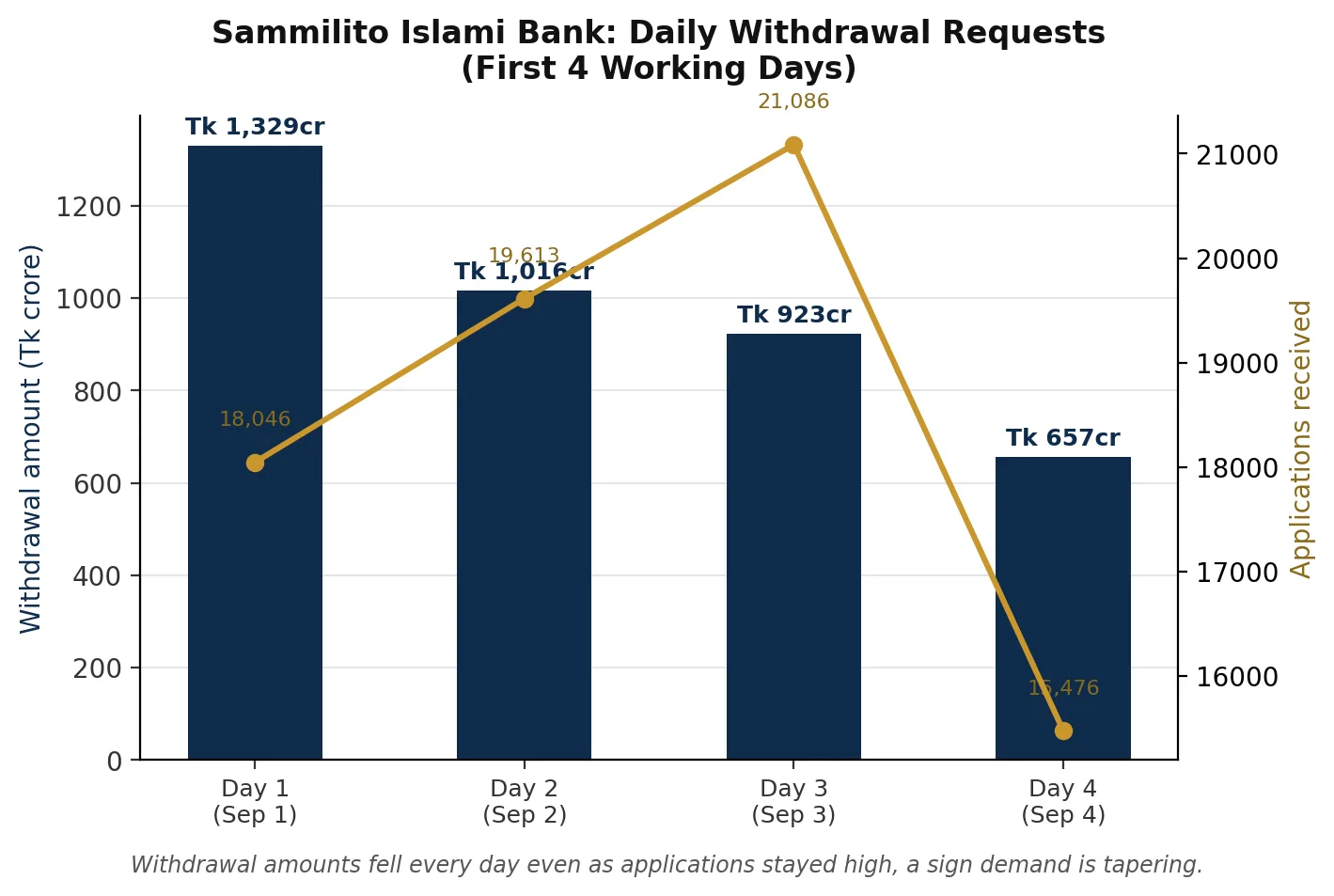
Chart: BD Financial Review
References
- 1Sammilito Islami Bank readies Tk5,000cr as withdrawal requests hits Tk4,000cr in 4 days
- 275,000 depositors seek to withdraw nearly Tk 4,000cr from Sammilito Islami Bank
- 3Customers withdraw Tk250cr as Sammilito Islami Bank begins deposit return
- 4Sammilito Islami Bank begins deposit returns, greets customers with flowers
- 5Sammilito Islami Bank's depositors can withdraw money from 7 September
Free calculators
All calculatorsEMI & loan calculator
Monthly installment, total interest and a full repayment schedule. Compare two loan offers side by side.
Zakat calculator
Work out your nisab status and the 2.5% zakat due on cash, gold, silver, savings and business assets.
FDR & DPS maturity calculator
Maturity amount for a fixed deposit or monthly deposit scheme, after compounding and source tax.
Read next

Bangladesh Bank's Tk2,000 Crore Frozen Food Fund Picks Up Four Banks in a Week
Bangladesh Bank has signed up a fourth commercial bank in just over a week to channel pre-financing loans from its Tk2,000 crore fund for frozen food exporters. The scheme offers concessional loans at up to 7 percent to shrimp, fish and other frozen food producers who are struggling with falling demand in the US and Europe. Mercantile Bank, NRBC Bank, IFIC Bank and Community Bank have all signed participation agreements since the start of November. The push comes as Bangladesh's frozen food exporters look for new buyers to replace shrinking orders from their traditional Western markets.

Bangladesh Bank Flips the Funding Order on Its Tk20,000 Crore Factory Revival Scheme After Banks Barely Touch It
Bangladesh Bank has rewritten the rules of its Tk20,000 crore factory revival scheme after only about 7 percent of the money had reached borrowers five months in. Banks must now lend their own funds first and seek reimbursement afterward, a reversal of the original upfront funding model, alongside a new name, board level approval requirements and anti fraud declarations. The changes signal how much slack remains in Bangladesh's effort to reopen factories shut by cash flow strain.

Islami Bank Plans a Fivefold Capital Jump to Tk10,000 Crore After a Record Quarterly Loss
Islami Bank's board has approved a plan to raise its authorised capital fivefold, from Tk2,000 crore to Tk10,000 crore, a day after the lender disclosed a Tk1,970 crore loss for July to September, its worst quarterly result in years. The plan still needs clearance from Bangladesh Bank and shareholder approval at an Extraordinary General Meeting before any new shares can actually be issued. Shares fell to Tk21.20 on the announcement, extending a slide that had already pushed the stock below Tk20 earlier in the week. The bank says the higher capital ceiling is part of a broader push to rebuild its balance sheet after losses tied to embezzlement by connected parties on large legacy loans.