Bangladesh Bank Lets More Borrowers Use Offshore Dollar Deposits as Loan Collateral
A new Bangladesh Bank circular issued Thursday evening opens up local-currency borrowing against foreign currency held in Offshore Banking Unit accounts to a much wider group of customers. Individual residents, consumer-finance borrowers, and non-resident Bangladeshis can now tap the facility, which was previously limited mostly to companies and firms. No exact lending limits were published, but the central bank says the goal is simply broader access to taka financing without disturbing dollar savings.
Bangladesh Bank widened the pool of customers who can borrow taka against foreign currency balances held with Offshore Banking Units on Thursday evening, a change that opens the door for ordinary individual account holders and non-resident Bangladeshis to tap a financing route that had been used mainly by companies and business firms.
Offshore Banking Units, commonly referred to as OBUs, are separate windows within Bangladeshi banks that are licensed to accept and hold deposits in foreign currency, largely serving exporters, foreign investors, and non-resident Bangladeshis who want to keep savings in dollars or other hard currencies rather than converting everything into taka. Until now, the balances sitting in those accounts could only be pledged as collateral for short-term working capital loans in local currency, and only for resident companies, firms, and individuals operating in a business capacity.
Under the circular issued on September 3, that scope has been expanded in two directions at once. First, authorised dealer banks can now extend short-term finance or consumer finance in local currency to resident persons using their OBU foreign currency balances as security, a category that covers everyday borrowing needs such as personal loans rather than only business working capital. Second, and perhaps more significantly, non-resident Bangladeshis holding OBU accounts are now explicitly included among those eligible to use their foreign currency holdings as loan collateral.
The central bank framed the move in straightforward terms, stating that it aims at widening financing options against foreign currency balances maintained with OBUs and providing greater access to local-currency financing against such deposits. In practice, that means a non-resident Bangladeshi who has parked savings in an OBU dollar account, rather than repatriating and converting them, can now use that balance to secure a taka loan without having to liquidate the foreign currency position or bring the money into the country outright.
That distinction matters more than it might first appear. For many non-resident Bangladeshis, foreign currency savings held offshore or in OBU accounts serve as a store of value that also hedges against taka depreciation, a real concern given the currency's history of periodic devaluation pressure. Being forced to convert those dollars into taka in order to access local financing, for instance to fund a family expense, a property purchase, or an investment back home, effectively meant giving up that currency hedge. The new rule lets borrowers keep their foreign currency intact as collateral while still drawing on taka liquidity for domestic needs, a structure that mirrors how foreign-currency-backed lending already works in several other economies with large diaspora populations.
The practical mechanics of an OBU-collateralised loan are worth spelling out for anyone considering the option. A borrower does not withdraw or transfer the foreign currency itself. Instead, the bank places a lien on the OBU deposit, meaning the funds stay exactly where they are and continue earning whatever return the OBU account offers, while the bank extends a separate taka loan sized against that pledged balance. If the borrower repays the loan as scheduled, the lien is released and the original foreign currency deposit is untouched throughout. If they default, the bank has recourse to the pledged deposit rather than having to pursue other collateral or legal action, which is part of why banks can typically offer more favourable terms on this kind of secured lending than on an unsecured personal loan.
The change builds on groundwork laid in July 2025, when Bangladesh Bank first allowed Domestic Banking Units, the conventional banking side of the same institutions, to accept OBU-held foreign currency deposits as collateral. Thursday's circular extends and broadens that earlier permission rather than introducing an entirely new mechanism, which suggests the central bank has been monitoring how the original facility performed before deciding to widen its reach to individual and consumer borrowers.
Notably absent from the announcement were specific figures: no loan-to-value ratio, no cap on how much can be borrowed relative to the foreign currency balance pledged, and no explicit interest rate guidance. Authorised dealer banks are expected to set those commercial terms individually within the framework the central bank has laid out, which means the actual borrowing cost and available loan size will likely vary from one bank to another. Prospective borrowers interested in using the facility will need to approach their bank directly to find out what specific terms apply to their OBU account and what documentation the loan will require.
The consumer-finance dimension is also likely to matter for a segment of borrowers who have historically found themselves underserved by mainstream retail lending, resident Bangladeshis who hold meaningful foreign currency savings, whether from freelance work paid in dollars, overseas contracts, or family remittances channelled into an OBU account, but who lack the salaried-employment documentation that many banks require for conventional personal loans. For that group, a foreign-currency-backed facility can function as an alternative credit pathway, provided banks design the product with reasonably accessible documentation requirements rather than replicating the paperwork burden of unsecured lending.
For the broader banking sector, the move fits into a pattern seen through much of 2026, in which Bangladesh Bank has been gradually loosening various foreign exchange and financing rules in an effort to improve liquidity conditions without resorting to blunter tools like direct rate cuts. Similar circulars this week eased remittance rules for firms operating in Hi-Tech Parks, and the central bank resumed direct dollar purchases from the open market for the first time since May, buying 50 million dollars at Tk 122.75 per dollar as remittance inflows strengthened. Taken together, these steps point to a central bank trying to make foreign currency held by Bangladeshis, whether earned through exports, remittances, or overseas employment, more useful within the domestic financial system rather than sitting idle or flowing entirely outside formal banking channels.
For the sizeable Bangladeshi diaspora, particularly in the Middle East, North America, and the United Kingdom, the practical significance of Thursday's circular may only become clear once individual banks begin advertising specific products under the new rule. Non-resident Bangladeshis who maintain OBU accounts have historically had limited options for using those savings productively inside Bangladesh short of fully repatriating funds, and a working local-currency lending facility against those balances could open up financing for property purchases, family business investment, or education expenses for relatives back home without disturbing the underlying foreign currency holding. How quickly that potential translates into an actual, easy-to-use product will be the real test of whether Thursday's policy change delivers on its stated intent.
Whether the new consumer-finance provision sees meaningful uptake will depend heavily on how competitively individual banks price the loans and how much friction remains in the paperwork required to pledge an OBU balance as security. Banking analysts note that similar collateral-based facilities elsewhere often start slowly before gaining traction once a handful of early adopters demonstrate the process works smoothly, and this facility is likely to follow a comparable path over the coming months as banks roll out their own product terms under the new rule.
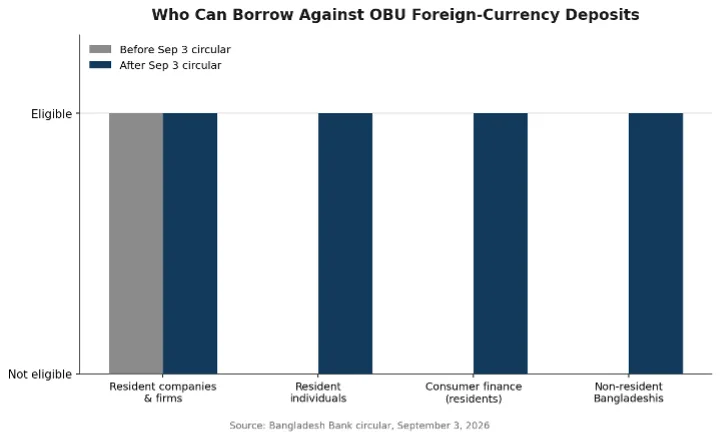
Who can borrow against OBU foreign-currency deposits, before and after the September 3 circular. Source: Bangladesh Bank.
References
Free calculators
All calculatorsEMI & loan calculator
Monthly installment, total interest and a full repayment schedule. Compare two loan offers side by side.
Zakat calculator
Work out your nisab status and the 2.5% zakat due on cash, gold, silver, savings and business assets.
FDR & DPS maturity calculator
Maturity amount for a fixed deposit or monthly deposit scheme, after compounding and source tax.
Read next

National Bank Begins Repaying Depositors, Under 11 New Conditions
National Bank PLC reopened its counters on October 15 and started paying out the roughly 11,000 customers who had been asking for their money for four days. Behind that lies a Tk7,000 crore emergency loan from Sonali Bank, eleven conditions Bangladesh Bank attached to it, and a balance sheet with an advance-to-deposit ratio of 132 percent, far above the regulatory ceiling.

Foreign Banks in Bangladesh See Profit Fall 38% in H1 While Treasury Bets Lift Domestic Rivals
Bangladesh's nine foreign commercial banks saw combined net profit fall 38% to Tk2,321 crore in the first half of 2026, hit by weak trade financing and energy shortages. At the same time, many domestic listed banks posted strong profit growth, driven almost entirely by investment income from government securities rather than new lending. Foreign banks still carry a far lower bad loan ratio and much stronger capital buffers than the sector average.

Sonali Bank Lends National Bank Tk7,000 Crore as a Deposit Rush Tests Bangladesh's Bailout Plan
State-owned Sonali Bank has lent Tk7,000 crore to National Bank, fully guaranteed by Bangladesh Bank, after about 7,500 withdrawal requests arrived at the troubled lender in three days. The loan is meant to help National Bank meet an October 15 deadline to resume full withdrawals. The bank still owes the central bank over Tk10,000 crore from an earlier unpaid loan, a reminder of how deep its problems, rooted in the Sikder family era, still run.