Bangladesh Bank Resumes Dollar Buying as Remittances Flood the Market, Ending a Three-Month Pause
Bangladesh Bank bought $50 million from four commercial banks on September 1 at Tk122.75 per dollar , its first dollar purchase since May 20, ending a roughly three-month pause. Strong remittance inflows and soft import demand had been pushing the taka-dollar rate down, and the move signals how exchange-rate stability, bank liquidity and FDR pricing are quietly connected.
Bangladesh Bank Resumes Dollar Buying as Remittances Flood the Market, Ending a Three-Month Pause
For the first time since May, Bangladesh Bank stepped back into the foreign exchange market on September 1 and bought dollars from commercial banks , a small transaction in dollar terms, but a signal that matters for anyone who changes money, sends remittances home, or watches the taka dollar rate today to plan a business shipment.
The central bank purchased $50 million from four commercial banks at Tk122.75 per dollar. It sounds like a routine treasury operation, and in one sense it is. But this was Bangladesh Bank's first dollar purchase since May 20, a gap of roughly three months during which the central bank sat on the sidelines even as the market expected it to step in. That pause, and the reason it just ended, tells a story about where Bangladesh's currency market stands right now , and what could be coming next for bank liquidity and, eventually, FDR pricing.
Why The Central Bank Had Been Staying Out
To understand why Tuesday's purchase mattered, it helps to understand why Bangladesh Bank had been absent for so long. Bankers say the central bank had actually been expected to buy dollars for about two weeks before September 1, given how the market was behaving, but it held back. The reason traces to the government's own dollar needs. After August 20, an additional $100 million in government letter-of-credit, or LC, payments landed on the books, pushing the central bank's outstanding foreign currency obligations above $1 billion. With that kind of payment pressure sitting on its balance sheet, Bangladesh Bank had little appetite to add fresh dollar purchases to the queue, even as the exchange rate softened and bankers waited for support.
In plain terms, the central bank was juggling two jobs it does simultaneously: paying out dollars to cover government import and loan obligations, while also managing how much local currency it injects into the banking system through dollar purchases. When the outgoing side of that ledger swelled past $1 billion, the incoming side , buying dollars from commercial banks , got parked.
What Changed: Too Many Dollars, Not Enough Demand
What finally pulled Bangladesh Bank back into the market wasn't a change in its own obligations. It was pressure from the other direction , a straightforward supply-and-demand story playing out in the interbank currency market. Remittances sent home by Bangladeshi workers abroad have been running strong, while demand for dollars from importers has stayed comparatively weak. That combination , plenty of dollars coming in through remittance channels, not enough being absorbed by import payments going out , created a surplus that started dragging the exchange rate lower.
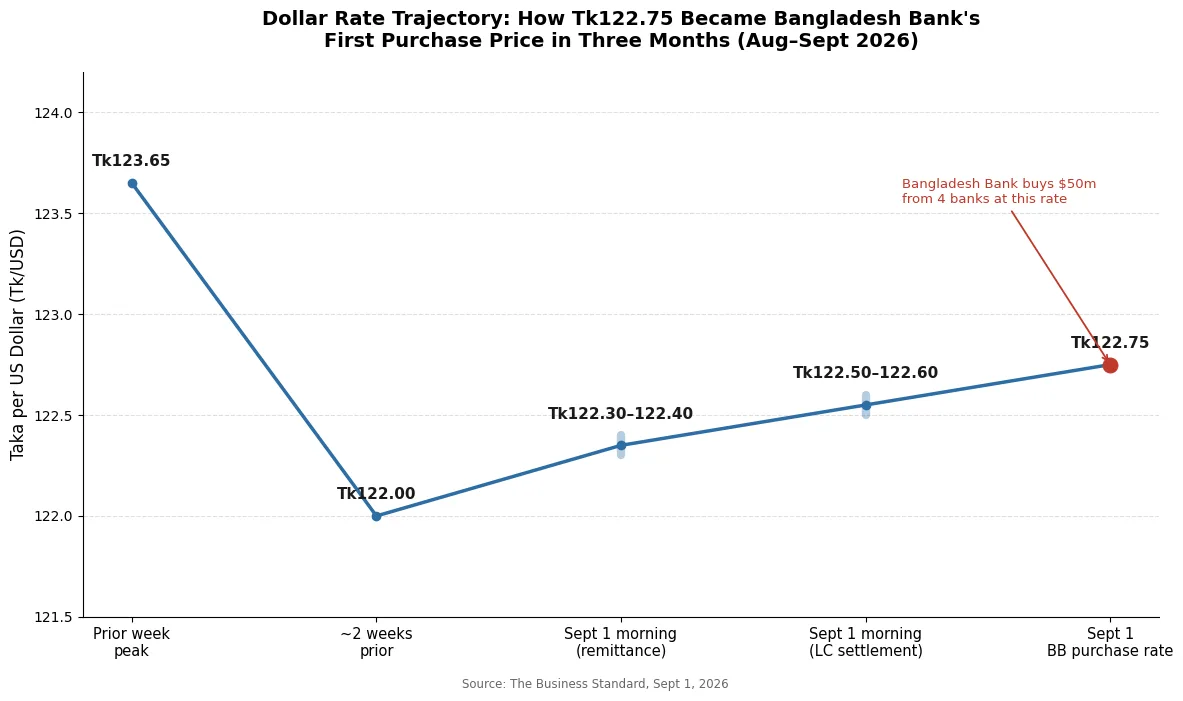
A senior banker described the dynamic bluntly: excess dollar supply amid subdued demand has been pushing the exchange rate down, and it was that downward drift that finally prompted Bangladesh Bank to step in and buy. The numbers tell the same story. The dollar had actually climbed as high as Tk123.65 the week before, a level that reflected tighter supply conditions at the time. But roughly two weeks earlier than that, it had already slipped to around Tk122, and by the morning of September 1, banks were quoting the dollar even lower , between Tk122.30 and Tk122.40 for remittance purchases, and a slightly wider Tk122.50 to Tk122.60 for settling import LCs. That is a meaningful swing in a short window, and it is exactly the kind of volatility a central bank tries to smooth out rather than let the market absorb on its own.
How A Central Bank Dollar Purchase Actually Works
For anyone outside the banking industry, "Bangladesh Bank buys dollars from commercial banks" can sound abstract. The mechanics are actually fairly intuitive once you break them down. When remittances and export earnings bring more dollars into the country than importers need to spend, commercial banks end up holding surplus dollars on their books. If nobody buys those dollars, banks compete to offload them, and the price of a dollar in taka terms falls , which is exactly what was happening through late August.
Bangladesh Bank's move to buy $50 million at Tk122.75 does two things at once. First, it puts a floor under the exchange rate: by stepping in as a buyer at a specific price, the central bank effectively tells the market "this is roughly where we think the rate should sit," and other banks tend to fall in line. That is precisely what happened on September 1 , after the afternoon purchase was announced, several commercial banks raised their own quoted rates to match Bangladesh Bank's Tk122.75 benchmark, arresting the earlier slide. Second, every dollar the central bank buys is paid for in taka, which means the purchase injects fresh taka liquidity into the banking system , the flip side of the taka liquidity that gets withdrawn when Bangladesh Bank sells dollars to cover government LC payments, as it had been doing through most of the pause.
There was also a logistical wrinkle worth noting for how markets absorb this kind of news. Bangladesh Bank typically signals its daily rate expectations to the market by around 11:30am. On September 1, that notification came late , closer to 1pm , which left some banks briefly unprepared and created a short stretch of operational uncertainty before the market settled around the new Tk122.75 reference point. It is a small detail, but it is the kind of thing treasury desks at commercial banks watch closely, because timing signals as much as the number itself.
What It Means For Depositors, Importers And Ordinary Bank Customers
None of this is abstract for people who bank, borrow or send money across the Bangladesh-dollar corridor. A softer, more stable dollar rate is broadly good news for importers, since it lowers the taka cost of paying for everything from raw materials to finished goods purchased abroad , a factor that eventually feeds through to consumer prices. For families receiving remittances, a lower dollar rate technically means slightly less taka per dollar sent home, though the flip side is that strong remittance volumes are precisely what is keeping the exchange rate stable rather than climbing the way it did the week it hit Tk123.65.
The liquidity angle is where this story connects most directly to bank deposits and fixed deposit receipts, or FDRs. When Bangladesh Bank buys dollars, it releases taka into the banking system, easing the same kind of liquidity pressure that has been pushing banks to compete for deposits with attractive FDR rates over the past year. That effect works alongside the central bank's broader policy stance: Bangladesh Bank cut its policy rate from 10 percent to 9.5 percent effective August 2, 2026, the first rate cut in six years, alongside a reduction in the Standing Lending Facility rate from 11.5 percent to 11 percent, while holding the Standing Deposit Facility steady at 7.5 percent. Governor Md Mostaqur Rahman has signaled a preference for monetary easing to support growth, and small, steady taka injections through dollar purchases like this one are a quieter, less-discussed channel through which that easing bias shows up in day-to-day bank liquidity , separate from, but complementary to, the headline rate cut.
For depositors, the practical takeaway is not dramatic in the short run , a single $50 million purchase will not move FDR rates on its own. But it is a data point worth watching. If Bangladesh Bank continues buying dollars in the weeks ahead, as strong remittance inflows suggest it might need to, the cumulative effect on system-wide taka liquidity could gradually ease the funding pressure that has kept FDR rates elevated at many banks, even after the recent policy rate cut.
Reserves Still Building, Even As The Central Bank Manages Daily Flows
The broader reserves picture offers useful context for why Bangladesh Bank can afford to be selective about when it buys and sells dollars. As of the most recent reporting, Bangladesh's gross foreign exchange reserves stood at $37.41 billion. Measured under the International Monetary Fund's BPM6 methodology, which is generally considered the more conservative and internationally comparable figure, reserves stood at $32.50 billion. Either measure represents a reserve cushion that gives the central bank room to manage short-term fluctuations in the exchange rate without panic , buying when supply is excessive, as it did on September 1, and selling to cover government obligations, as it had been doing through much of the prior three months, without either side of that balancing act threatening reserve adequacy.
What To Watch Next
The immediate question for banks, importers and remittance-dependent households alike is whether September 1 was a one-off intervention or the start of a more regular buying pattern. If remittance inflows stay strong into the Eid and year-end season , a period that typically sees elevated flows from Bangladeshi workers abroad , and import demand remains soft, Bangladesh Bank may find itself back in the market as a buyer more frequently than it has been over the past three months. That would mark a shift from the defensive, dollar-selling posture the central bank held through most of the summer to a more balanced role, buying on the way down and selling when government obligations demand it.
For now, the exchange rate has found a new anchor around Tk122.75, a level several commercial banks moved to match within hours of the central bank's purchase. Whether that holds through September, or whether remittance-driven dollar supply pushes it lower still, will shape not just the price importers and remittance-receiving families pay and receive, but the quieter liquidity conditions that determine how competitively banks price their next round of fixed deposits.
References
Free calculators
All calculatorsEMI & loan calculator
Monthly installment, total interest and a full repayment schedule. Compare two loan offers side by side.
Zakat calculator
Work out your nisab status and the 2.5% zakat due on cash, gold, silver, savings and business assets.
FDR & DPS maturity calculator
Maturity amount for a fixed deposit or monthly deposit scheme, after compounding and source tax.
Read next

Foreign Banks in Bangladesh See Profit Fall 38% in H1 While Treasury Bets Lift Domestic Rivals
Bangladesh's nine foreign commercial banks saw combined net profit fall 38% to Tk2,321 crore in the first half of 2026, hit by weak trade financing and energy shortages. At the same time, many domestic listed banks posted strong profit growth, driven almost entirely by investment income from government securities rather than new lending. Foreign banks still carry a far lower bad loan ratio and much stronger capital buffers than the sector average.

Sonali Bank Lends National Bank Tk7,000 Crore as a Deposit Rush Tests Bangladesh's Bailout Plan
State-owned Sonali Bank has lent Tk7,000 crore to National Bank, fully guaranteed by Bangladesh Bank, after about 7,500 withdrawal requests arrived at the troubled lender in three days. The loan is meant to help National Bank meet an October 15 deadline to resume full withdrawals. The bank still owes the central bank over Tk10,000 crore from an earlier unpaid loan, a reminder of how deep its problems, rooted in the Sikder family era, still run.

Bangladesh Bank Lets BRAC Bank's Biggest Shareholder Triple Its Board Seats
Bangladesh Bank has relaxed a board rule specifically for BRAC Bank, letting its largest shareholder appoint up to three representative directors instead of just one. The 12 October circular benefits BRAC, which an official said holds 46 percent of the bank's shares. It is the second such case-specific exemption this year, after a similar one for Trust Bank in March.