Sammilito Islami Bank Depositors Can Start Withdrawals September 7 but With a Catch

Depositors of the merged Sammilito Islami Bank PLC will finally be able to withdraw their FDR and deposit principal starting September 7, 2026, six days later than Bangladesh Bank's original target. There is a catch, though: withdrawing a Mudaraba term deposit's full principal in one go means forfeiting any profit earned on it. As the bank works through a capital shortfall exceeding Tk1,50,000 crore, the government is now looking to Qatar as a potential strategic partner.
Depositors of Sammilito Islami Bank PLC, the state-engineered merger of five distressed Shariah-based lenders, will finally be allowed to start withdrawing their deposit principal from September 7, 2026 , six days later than the date Bangladesh Bank had originally promised. The delay itself is procedural, officials say, but the more important story for the bank's roughly 76 lakh depositors is a catch buried in the fine print: pull out the full principal of a Mudaraba term deposit in one transaction, and you forfeit whatever profit has accrued on it.
A Week's Delay, Explained
On August 25, 2026, Bangladesh Bank Governor Md Mostaqur Rahman told reporters that individual depositors would be able to withdraw principal from Al-Wadiah current accounts, Mudaraba savings accounts and Mudaraba term deposits , the Islamic banking equivalent of a fixed deposit receipt , starting September 1. It was the clearest signal yet that the central bank considered Sammilito Islami Bank stable enough to loosen restrictions that had been in place since the merger closed.
Six days later, on August 31, Bangladesh Bank issued a formal circular pushing that date back to September 7. The reason given was logistical rather than financial: branches and sub-branches across the country needed more time to receive cash requisitions and put secure cash-management arrangements in place before large volumes of depositors could start walking in to withdraw money. For a bank stitched together from five separate institutions with different systems, branch networks and back-office processes, that kind of coordination is not trivial, and a premature start date risked exactly the sort of chaotic branch scenes regulators are trying to avoid.
The Catch: Full Withdrawal Means No Profit
The September 7 start date is welcome news on its face, but it comes with a condition depositors need to understand before they act. Anyone with a Mudaraba term deposit who withdraws the entire principal in a single transaction gives up any profit that has accrued on that deposit. To keep earning profit, a depositor has to stay enrolled in the bank's ongoing Bank Resolution Scheme rather than cash out in full.
In practice, this creates a real trade-off for depositors who have been anxiously waiting since the merger to get their money back. Someone who needs the full amount urgently, whether to cover a family expense or reinvest elsewhere, can now do so , but at the cost of profit already earned during the period their money was locked up. Someone who does not need the money immediately keeps earning profit by staying in the resolution scheme, but does not get full, unconditional access to the principal. Depositors who only just learned they could withdraw at all may not yet be aware the mechanism works this way, and financial advisers in Dhaka have already begun flagging it as a point of confusion.
It's worth setting this alongside a separate, reassuring signal from the central bank: on August 25, Governor Rahman also said there would be no further “haircut” on depositors' profits going forward. That matters because a haircut imposed on January 14, 2026 , covering profit for 2024-25 , is what triggered depositor protests at bank branches earlier this year in the first place.
How Sammilito Islami Bank Came to Exist
To understand why any of this matters, it helps to remember how unusual this bank is. Sammilito Islami Bank PLC began operations in November 2025 as a state-controlled merger of five Shariah-based lenders that had fallen into serious distress: First Security Islami Bank, Social Islami Bank, Global Islami Bank and Union Bank , all previously controlled by the S Alam Group , plus Exim Bank, which had been controlled by businessman Nazrul Islam Mazumder. Given their combined size and the number of depositors involved, regulators folded the five into a single entity rather than let any of them fail outright.
The scale of what regulators inherited is significant by any measure. The merged bank is carrying a capital shortfall of more than Tk1,50,000 crore. Total deposits across the institution stand at roughly Tk1,42,000 crore, spread across about 76 lakh individual depositors. On the asset side, combined loans total Tk1,92,000 crore, and Bangladesh Bank figures put close to 86% of that loan book in non-performing territory , an extraordinarily high NPL ratio even by the standards of Bangladesh's troubled Islamic banking sector, and the underlying reason the bank needed such an aggressive capital-repair plan in the first place.
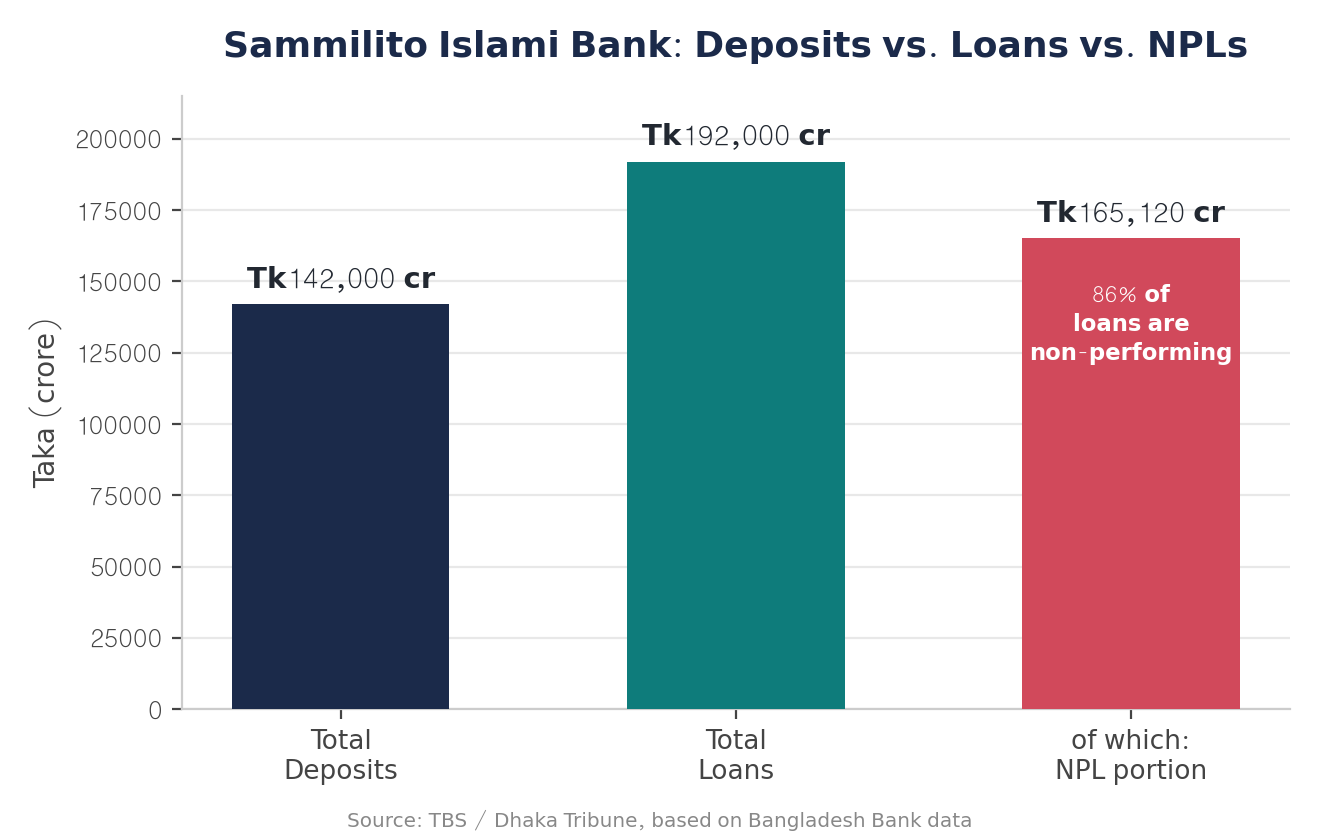
To rebuild the balance sheet, the bank's authorized capital has been set at Tk40,000 crore, with paid-up capital of Tk35,000 crore. Of that paid-up figure, Tk20,000 crore is coming directly from the government, while the remaining Tk15,000 crore is to be issued as shares to depositors themselves , effectively converting a portion of what depositors are owed into an equity stake in the bank's own recovery.
Government Turns to Qatar for a Strategic Partner
The recapitalization effort took a new turn on September 1, 2026 , the very day withdrawals were originally supposed to begin , when Finance Adviser Rashed Al Mahmud Titumir, speaking during a visit to Qatar, said the government has “already proposed that Qatar become a strategic partner” in Sammilito Islami Bank. Titumir framed the choice facing policymakers in blunt terms: either the government keeps funding the bank's recovery from the treasury, or it brings in a foreign country or organisation as an owner.
Bringing in a foreign strategic investor would mark a significant shift in how Bangladesh handles a bank rescue of this size. It would also test how much appetite exists among Gulf institutions for taking a stake in a lender still working through an 86% non-performing loan book, even with government backing and a rebuilt capital structure behind it. No terms, timeline or structure for a potential Qatari investment have been disclosed, and reporting on the talks frames this as an active search for partners across Muslim-majority countries rather than a completed, or even preliminarily agreed, deal.
What Depositors Should Actually Do
For the roughly 76 lakh people with money in Sammilito Islami Bank, the practical takeaway from this week's news is fairly straightforward, even if the underlying situation is complicated. Starting September 7, withdrawals of principal from current accounts, Mudaraba savings accounts and Mudaraba term deposits will be possible. Anyone planning a full withdrawal of a term deposit should go in understanding that doing so surrenders accrued profit, and should weigh that against simply staying in the resolution scheme if the money isn't needed immediately. Given that Bangladesh Bank has explicitly ruled out further profit haircuts, depositors who can afford to wait may find patience is now a less risky bet than it was earlier this year, when the entire resolution process felt far more uncertain.
Anyone with questions about a specific account should confirm details directly with their branch once the September 7 window opens, since the practical rollout , how quickly branches can process requests, whether queues form, how the Tk10 lakh emergency-withdrawal provision introduced earlier this year interacts with the new rules , will likely vary somewhat in the first few days.
The Broader Backdrop: Bank Deposits Are Losing to Inflation
It's worth separating the Sammilito Islami Bank story from a broader trend affecting ordinary savers across Bangladesh's banking system, because the two are easy to conflate but are not the same issue. Effective August 1, 2026, banks nationally cut deposit and FDR rates by 50 to 100 basis points, bringing the going range down to 8.50%-9.00% from the previous 9.00%-10.15%. That followed Bangladesh Bank's decision to cut its policy (repo) rate from 10% to 9.5% , announced July 30 and effective August 2, the first such cut in six years , alongside a newly imposed 4% cap on the spread banks can charge between lending and deposit rates.
The consequence for ordinary depositors is that FDR returns are now sitting below June 2026 inflation of 9.16%, meaning the real, inflation-adjusted return on a standard bank fixed deposit has turned negative. That's a distinct phenomenon from what is happening at Sammilito Islami Bank , it affects savers at healthy, well-capitalized banks too , but it adds useful context for readers trying to understand the environment Bangladeshi depositors are navigating this year: a banking sector working through both a major restructuring at one merged institution and a system-wide squeeze on what ordinary savings actually earn.
Between the September 7 withdrawal window, the no-more-haircuts pledge, and now the outreach to Qatar, the past week has produced more concrete movement on Sammilito Islami Bank's recovery than at any point since the merger closed last November. Whether a foreign strategic partner actually materializes, and how quickly the bank can work down an NPL ratio north of 85%, will likely shape the next phase of this story far more than any single withdrawal date.
References
- 1Sammilito Islami Bank's depositors can withdraw money from 7 September | The Business Standard
- 2Govt seeking strategic partner in Muslim countries for Sammilito Islami Bank | The Business Standard
- 3No profit haircut for Sammilito Islami Bank depositors: BB governor | The Daily Star
- 4BB makes crucial decisions regarding Sammilito Islami Bank | Dhaka Tribune
- 5Banks push deposit returns further below inflation | The Business Standard
- 6BB cuts policy rate to 9.5%, first reduction in six years | The Daily Star
Free calculators
All calculatorsEMI & loan calculator
Monthly installment, total interest and a full repayment schedule. Compare two loan offers side by side.
Zakat calculator
Work out your nisab status and the 2.5% zakat due on cash, gold, silver, savings and business assets.
FDR & DPS maturity calculator
Maturity amount for a fixed deposit or monthly deposit scheme, after compounding and source tax.
Read next

Foreign Banks in Bangladesh See Profit Fall 38% in H1 While Treasury Bets Lift Domestic Rivals
Bangladesh's nine foreign commercial banks saw combined net profit fall 38% to Tk2,321 crore in the first half of 2026, hit by weak trade financing and energy shortages. At the same time, many domestic listed banks posted strong profit growth, driven almost entirely by investment income from government securities rather than new lending. Foreign banks still carry a far lower bad loan ratio and much stronger capital buffers than the sector average.

Sonali Bank Lends National Bank Tk7,000 Crore as a Deposit Rush Tests Bangladesh's Bailout Plan
State-owned Sonali Bank has lent Tk7,000 crore to National Bank, fully guaranteed by Bangladesh Bank, after about 7,500 withdrawal requests arrived at the troubled lender in three days. The loan is meant to help National Bank meet an October 15 deadline to resume full withdrawals. The bank still owes the central bank over Tk10,000 crore from an earlier unpaid loan, a reminder of how deep its problems, rooted in the Sikder family era, still run.

Bangladesh Bank Lets BRAC Bank's Biggest Shareholder Triple Its Board Seats
Bangladesh Bank has relaxed a board rule specifically for BRAC Bank, letting its largest shareholder appoint up to three representative directors instead of just one. The 12 October circular benefits BRAC, which an official said holds 46 percent of the bank's shares. It is the second such case-specific exemption this year, after a similar one for Trust Bank in March.