NBR Weighs Reversing Course on VAT Payments as Quarterly System Leaves a Tk 17,663 Crore Hole

Barely months after easing the compliance burden on businesses by letting them file and pay VAT once a quarter instead of every month, the National Board of Revenue is now weighing whether to reverse that decision. Collections in July and August fell nearly 22 percent from a year earlier, a Tk 17,663 crore shortfall that has put officials and over eight lakh VAT-registered businesses on a collision course.
Tax policy rarely reverses itself this quickly, but that is exactly the position the National Board of Revenue finds itself in barely a season after it eased one of the more welcomed compliance reforms of the year. Earlier in 2026, the NBR allowed VAT-registered businesses to submit returns and make payments once every three months instead of the previous monthly requirement, a change that was widely praised by the business community as a genuine reduction in paperwork and hassle. Now, with collections falling sharply short of targets, the same authority is openly considering walking that decision back.
The numbers behind the reconsideration are stark. VAT collection in July 2026 came in at Tk 9,301 crore, down from Tk 11,547 crore in the same month last year, a decline of 19.4 percent. August was worse, with collections of Tk 8,362 crore against Tk 11,081 crore a year earlier, a 24.5 percent drop. Taken together, the two months brought in Tk 17,663 crore against Tk 22,628 crore in the same period of the previous fiscal year, a combined shortfall of 21.9 percent at precisely the moment the government most needs revenue to flow in reliably.
An NBR official, speaking about the internal deliberations, put the dilemma plainly: after three months, it will be possible to understand whether the decision to allow returns and VAT payments after three months instead of every month was self-defeating for the government. That is a notable admission from within the tax authority itself, essentially conceding that a policy designed to make life easier for businesses may have inadvertently made it easier for VAT revenue to arrive late, arrive in smaller installments, or in the worst case, not arrive at all until enforcement catches up with non-filers.
The logic connecting quarterly filing to a revenue slowdown is not hard to follow once you think about how VAT actually reaches the government's coffers. Under a monthly system, a business has to reconcile its books, calculate what it owes, and hand over that money to the NBR twelve times a year, creating a steady and predictable cash flow into public coffers and a regular compliance habit for the business itself. Move that same obligation to a quarterly cycle, and a business effectively gets three months of breathing room, during which cash meant for VAT payments can sit in the business's own accounts, get redirected toward other short-term needs, or simply get deprioritized until the filing deadline looms. For a company managing tight working capital, and plenty of businesses in Bangladesh operate on razor-thin liquidity, that three-month gap is a real temptation to delay.
Unsurprisingly, the businesses that benefited most from the quarterly switch are not eager to see it undone. Debabrata Roy Chowdhury, a former director at Nestle Bangladesh who has been a vocal voice on tax policy in the private sector, warned that reversing course now would directly conflict with the government's own stated efforts to reduce the hassle businesses face in complying with tax rules. His argument reflects a broader unease in the business community: that regulatory back-and-forth, even when well-intentioned, erodes the predictability that companies need to plan around, and that every reversal makes businesses more skeptical of the next reform, whichever direction it goes.
That skepticism is not limited to large corporates. Amir Hossain Nurani, a small business owner who would be directly affected by any reversion to monthly filing, put the frustration in blunter terms, saying that if the government provides a facility and then withdraws it, that does not uphold its commitment to making business easier. For smaller firms without dedicated accounting staff, the shift from quarterly back to monthly filing is not a minor administrative tweak, it means finding the time, and often the money to pay an accountant, twelve times a year instead of four.
This is not the first time Bangladesh's tax administration has struggled to find a stable rhythm on filing frequency. Businesses and tax consultants alike point out that VAT rules, deadlines, and filing mechanics have been adjusted repeatedly over recent years, from shifts in online return filing requirements to periodic deadline extensions for both individual and corporate taxpayers, each one requiring firms to update software, retrain accounting staff, and communicate changes down to branch and vendor level. Every additional change, even one aimed at fixing a genuine revenue problem, adds to what economists call compliance fatigue, the growing reluctance of taxpayers to invest in adapting to a rule that might itself be reversed again within a year or two.
The scale of what is at stake is significant. More than eight lakh businesses are currently registered for VAT in Bangladesh, meaning any change to the filing cycle ripples across a huge cross-section of the economy, from large manufacturers and importers down to neighborhood retailers and service providers who only recently adjusted their internal processes to the quarterly rhythm. Reversing the policy now would mean asking all of them to re-adjust a second time within the same fiscal year, a level of policy whiplash that tax consultants say could itself dent compliance rates further, at least in the short term, as businesses scramble to update systems and habits yet again.
The NBR's dilemma sits inside a much larger revenue puzzle the government is grappling with this fiscal year. Officials have already flagged an estimated Tk 88,000 crore shortfall against the FY26 revenue target, a gap made more painful by a new public sector pay scale that adds roughly Tk 1.06 lakh crore in annual government spending, on top of an FY27 collection target set 46 percent higher than what is realistically being achieved today. Against that backdrop, a fix that could claw back even a portion of the VAT shortfall carries real weight in Dhaka's budget planning, which helps explain why officials are willing to reconsider a popular reform so soon after introducing it.
For now, the NBR has stopped short of announcing a final decision, with the official quoted suggesting a genuine wait-and-watch approach over the next quarter before any formal reversal is confirmed. Businesses, meanwhile, are left in an uncomfortable position, uncertain whether to plan around the current quarterly system or brace for a return to monthly obligations that could arrive with little warning. How the NBR resolves this tension between easing compliance and protecting revenue will likely shape how much trust the business community places in the next round of tax reforms, whichever direction they take. Businesses that want to avoid being caught off guard should watch for a formal NBR circular or gazette notification before assuming any change is final, since past reversals of this kind have typically come with several weeks of advance notice to allow accounting systems to be updated.
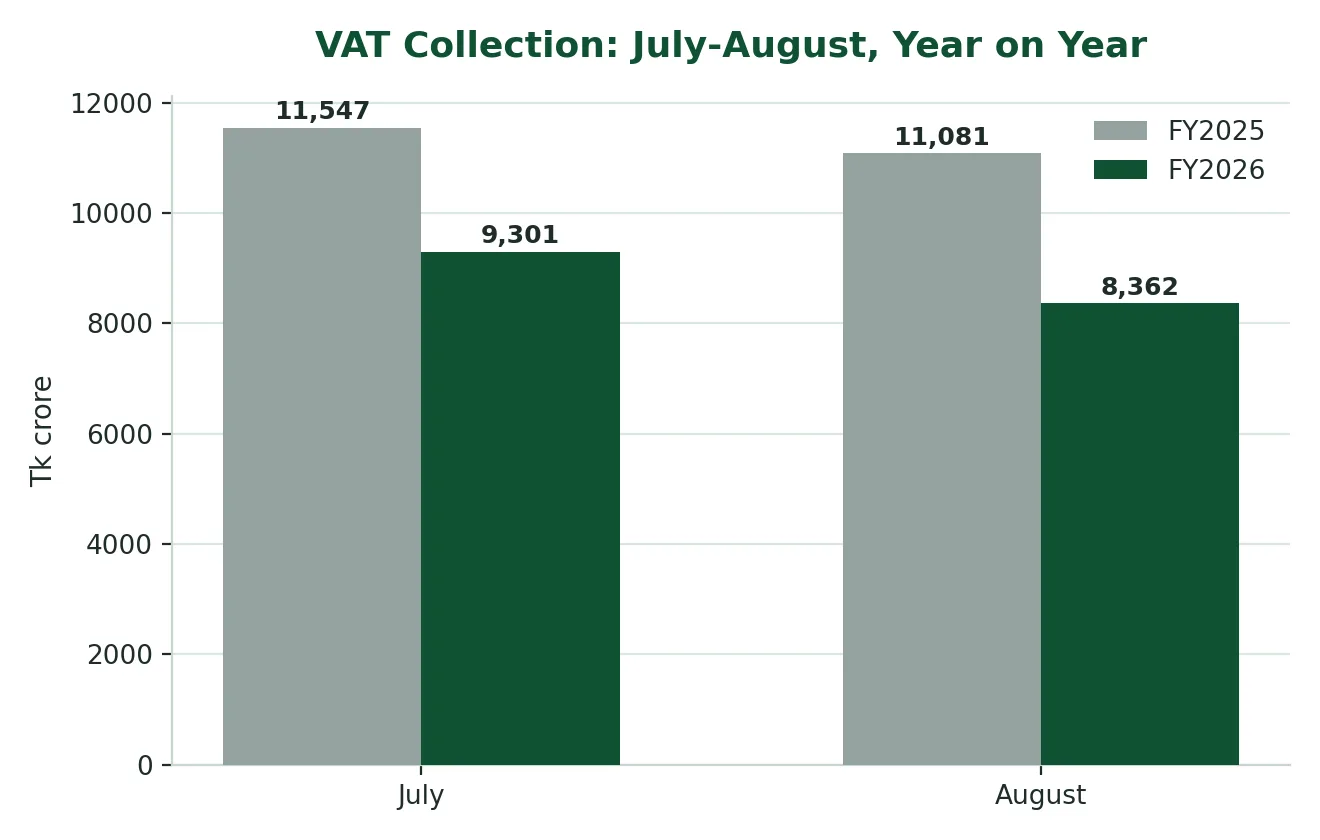
VAT Collection, July-August, Year on Year (Tk crore)
References
Read next
NBR Now Has to Fund the New Pay Scale Too , And Its Revenue Is Falling, Not Rising
Just days after bdfinancialreview.com reported NBR's Tk88,000 crore FY26 shortfall and its ambitious FY27 target, a new complication has emerged: the government is leaning on NBR to fund a Tk1.06 lakh crore annual pay scale hike for roughly 24 lakh employees and 9 lakh pensioners. The catch , VAT collections actually fell year-on-year in both July and August, making the 46% higher target look further out of reach, not closer.
NBR's Tk88,000 Crore Shortfall and Its Bold Tk6.04 Lakh Crore Target for the Year Ahead
The National Board of Revenue missed its FY26 target by roughly Tk88,000 crore even after 12 percent growth, and its former chairman has just been sent to Washington as Bangladesh's alternate executive director at the World Bank. Meanwhile, NBR is chasing a 20 percent higher target this year. Here is what the numbers mean for taxpayers, and why the gap keeps widening.
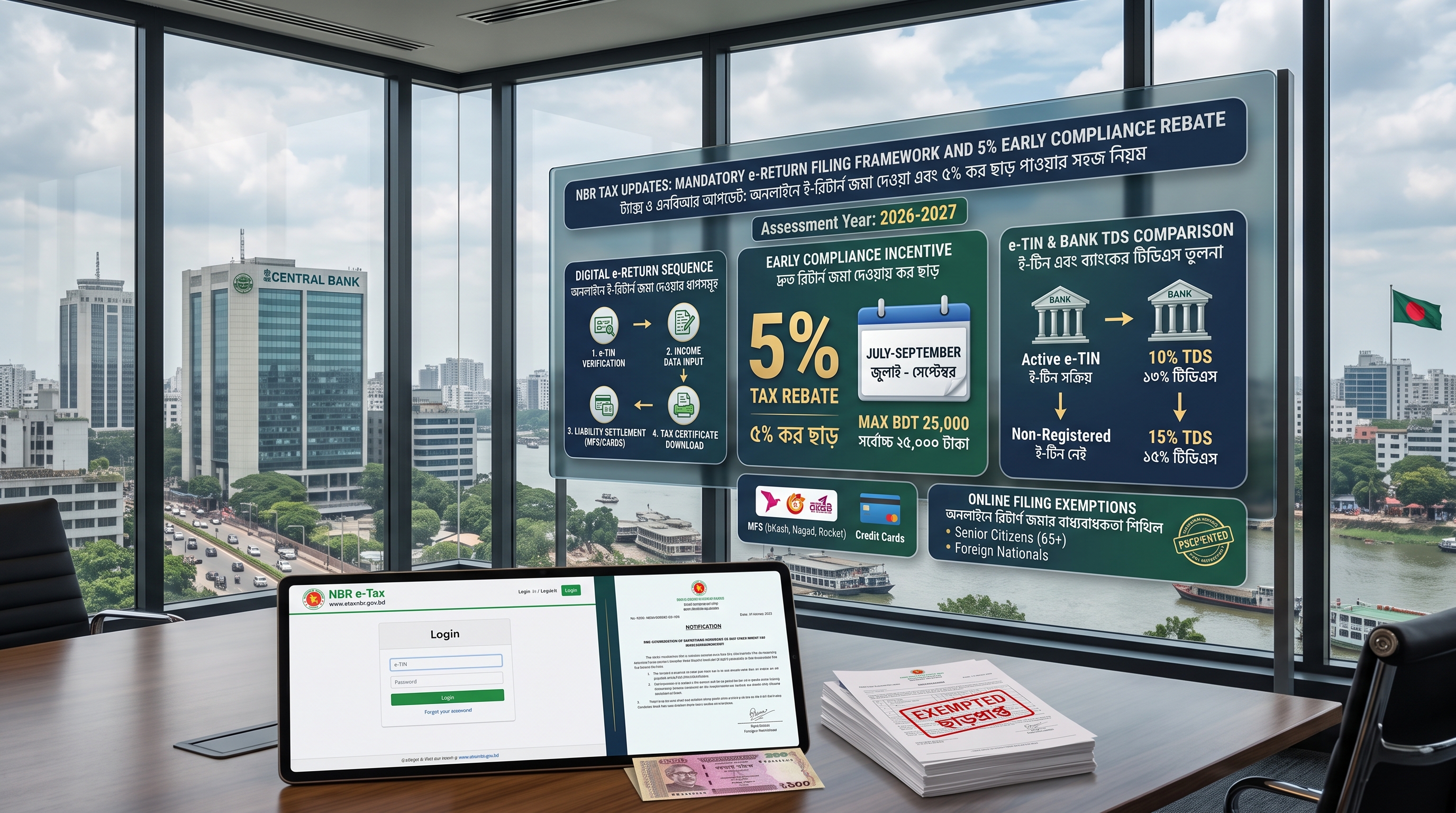
Mandatory e-Return Filing Framework and 5% Early Compliance Rebate
A guide to the National Board of Revenue’s online income tax filing rules for the 2026–2027 assessment year, detailing e-Return portal steps, tax rebate incentives up to BDT 25,000, and compliance deadlines.