Tax & Regulation

Bangladesh Gives Ministries an October 25 Deadline to Map Out the Fiscal Year Switch to April March

Bangladesh's Cabinet Division has told every ministry and its subordinate offices to submit, by October 25, a time bound plan for rewriting the laws, rules and systems that still assume a July to June fiscal year. The instruction is the first real test of the government's August decision to shift the fiscal year to April through March starting in 2028-29. A separate, smaller deadline change lands the same week, with the tax authority pushing back the VAT return filing date to October 25 as well.

October 16, 2026Read more

Thirteen Years After the Bacchu Scandal, BASIC Bank Still Can't Climb Out of Its Bad Loan Hole

BASIC Bank's September 2026 figures show 64.49 percent of its loan book, or Tk8,153 crore, still classified as bad, more than thirteen years after the Sheikh Abdul Hye Bachchu era loan scam first came to light. The bank is sitting on a Tk5,148 crore capital shortfall and a Tk5,051 crore provisioning gap, and its top 20 defaulters alone owe Tk2,288 crore of which only about 2 percent has ever been recovered. Chairman Helal Ahmed Chowdhury says a turnaround is possible within three years if the bank gets Tk5,000 crore in low cost deposits, but BASIC's bad loan ratio remains far above the 32.78 percent average across Bangladesh's banking sector. The bank's struggles mirror a wider problem among the country's five state owned banks, whose combined non performing loans climbed by Tk6,304 crore in just the first half of this year.

October 4, 2026Read more

NBR Misses VAT Targets in 85 Percent of Sectors as New BIN Mandate Squeezes Small Businesses

Newly released FY26 figures show 29 of 34 large taxpayer units missed their VAT collection targets, leaving a roughly Tk20,500 crore shortfall against a Tk108,000 crore goal even as officials now admit many targets were set without adequately considering economic conditions. At the same time, a 2012 statutory requirement for a Business Identification Number to open a bank account or secure a loan is being enforced in earnest, landing hardest on cottage, micro, small and medium enterprises that make up 99 percent of Bangladesh's 11.7 million economic units. NBR says neither banks nor its own officials can waive the BIN rule administratively, even as the Association of Bankers, Bangladesh has formally requested an exemption or phased rollout for the smallest businesses. Together the two tracks describe a revenue board falling short with large taxpayers able to resist while tightening its grip on businesses with the least capacity to comply quickly, a pattern tied to the government's own widening need to borrow from banks this quarter.

October 3, 2026Read more

NBR Uncovers Tk2,450 Crore Cigarette Filter Smuggling Scheme Run Through Ghost Import Companies

Bangladesh's tax intelligence unit has traced a cigarette filter raw material smuggling scheme worth up to Tk2,450 crore in potential lost revenue to a Motijheel trading firm that appears not to exist at all. Customs officers seized 48 tonnes of cellulose acetate tow at Chattogram port in August after failing to locate the importer of record, Unique Traders, which had brought in 363 tonnes of the material over the past fiscal year while reporting zero sales. Four more firms showing similar patterns have since been flagged, and the government has moved to restrict raw material imports to licensed manufacturers only. The case echoes a nearly identical smuggling ring uncovered in 2024, raising questions about how much of the newly flagged revenue will ever actually be recovered.

September 25, 2026Read more

Bangladesh Tightens Bank Accountability With New Anti Money Laundering Signature Rule

Bangladesh's financial intelligence unit ordered bank chief executives to personally co-sign compliance filings with regulators starting September 20, closing a loophole that let institutions submit inspection responses without sign off from the person actually running them. The rule follows a September 15 circular forcing brokerages and asset managers to build bank grade anti money laundering units, and an April directive requiring bank chairmen to sign anti corruption pledges. Together the three circulars mark one of the most concerted governance pushes Bangladesh's financial regulators have mounted in months, aimed squarely at making named individuals, not just institutions, accountable for compliance failures.

September 22, 2026Read more

NBR Weighs Reversal of Quarterly VAT System After Two Months of Falling Revenue

Barely two months after switching businesses from monthly to quarterly VAT payments, Bangladesh's National Board of Revenue is now weighing a reversal, after VAT collections fell roughly 20 percent year on year in July and August. The board says it is struggling to monitor tax risk once businesses can legally hold collected VAT for up to three months before handing it to the treasury, but business groups warn that flip flopping on the rules so soon would undercut the very compliance reforms the quarterly system was meant to deliver. A final decision is now awaiting approval from the top of government, with businesses due to file their first quarterly returns by the end of September regardless of what NBR decides.

September 20, 2026Read more

NBR Slashes Solar Equipment Import Tax From 17% to 1% as Bangladesh's Energy Crisis Deepens

Bangladesh's National Board of Revenue has cut the import tax on most solar power equipment to just 1 percent for the next 180 days, down from an effective 17 percent, covering everything from panels and inverters to the lithium batteries that store the power they generate. The order is less a brand new incentive than a long overdue fix, since a far more sweeping 0 percent tax package announced in June's national budget had left customs houses charging some importers duties as high as 23 to 64 percent months later, thanks to unresolved confusion over which equipment actually qualified. The tax cut lands squarely in the middle of a gas and electricity crunch that has forced garment factories to request zonal gas rationing and has become the backdrop to nearly every major economic story in Bangladesh this month.

September 18, 2026Read more

Bangladesh Bank Orders Banks and Mobile Wallets to Cut Off 30 Illegal Loan Apps Accused of Blackmail

Bangladesh Bank has ordered every bank, mobile financial service provider and payment operator in the country to immediately cut off payment services to 30 named illegal lending apps accused of charging effective interest rates as high as 800 percent and blackmailing borrowers with data harvested from their phones. The September 17 directive is at least the fourth enforcement attempt in six weeks, after two earlier Google takedown requests and a public warning failed to get several of the apps off the Play Store, with one flagged app still logging over a million downloads as recently as early September. Victims interviewed by reporters describe a consistent pattern, small loans of a few thousand taka spiraling into tens of thousands through hidden fees and daily compounding, followed by threats to friends and family when repayment stalls.

September 18, 2026Read more

BFIU Orders Every Brokerage and Merchant Bank in Bangladesh to Set Up Anti Money Laundering Units

Bangladesh's Financial Intelligence Unit has directed every brokerage house, merchant bank, portfolio manager, securities custodian and asset management company to set up a formal anti money laundering compliance unit, led by a chief compliance officer at head office and branch level officers below. The September 15 order requires strict customer verification, transaction monitoring through the GoAML system, five year record retention and twice yearly independent self assessments. It arrives as Bangladesh's securities regulator continues working through roughly Tk1,497 crore in fines from manipulation cases tied to the previous political era, including penalties against Salman F Rahman and companies linked to Beximco. Smaller brokerages without existing compliance infrastructure face a significant operational lift to comply.

September 16, 2026Read more

Former Land Minister Faces UK Bankruptcy Action Over 185 Million Pound Property Empire

SBAC Bank has petitioned London's High Court to have former land minister Saifuzzaman Chowdhury declared bankrupt, opening a new front in Bangladesh's effort to recover fortunes built abroad by allies of the ousted Awami League government. Britain's National Crime Agency has already frozen 342 properties tied to Chowdhury and his family worth roughly 185 million pounds, financed in part through a bridging lender that has since collapsed. The case shows how tracing money that left Bangladesh after the 2024 political transition has proven far easier than actually bringing it home, with years of parallel legal proceedings typically standing between a frozen asset and a repatriated one.

September 12, 2026Read more

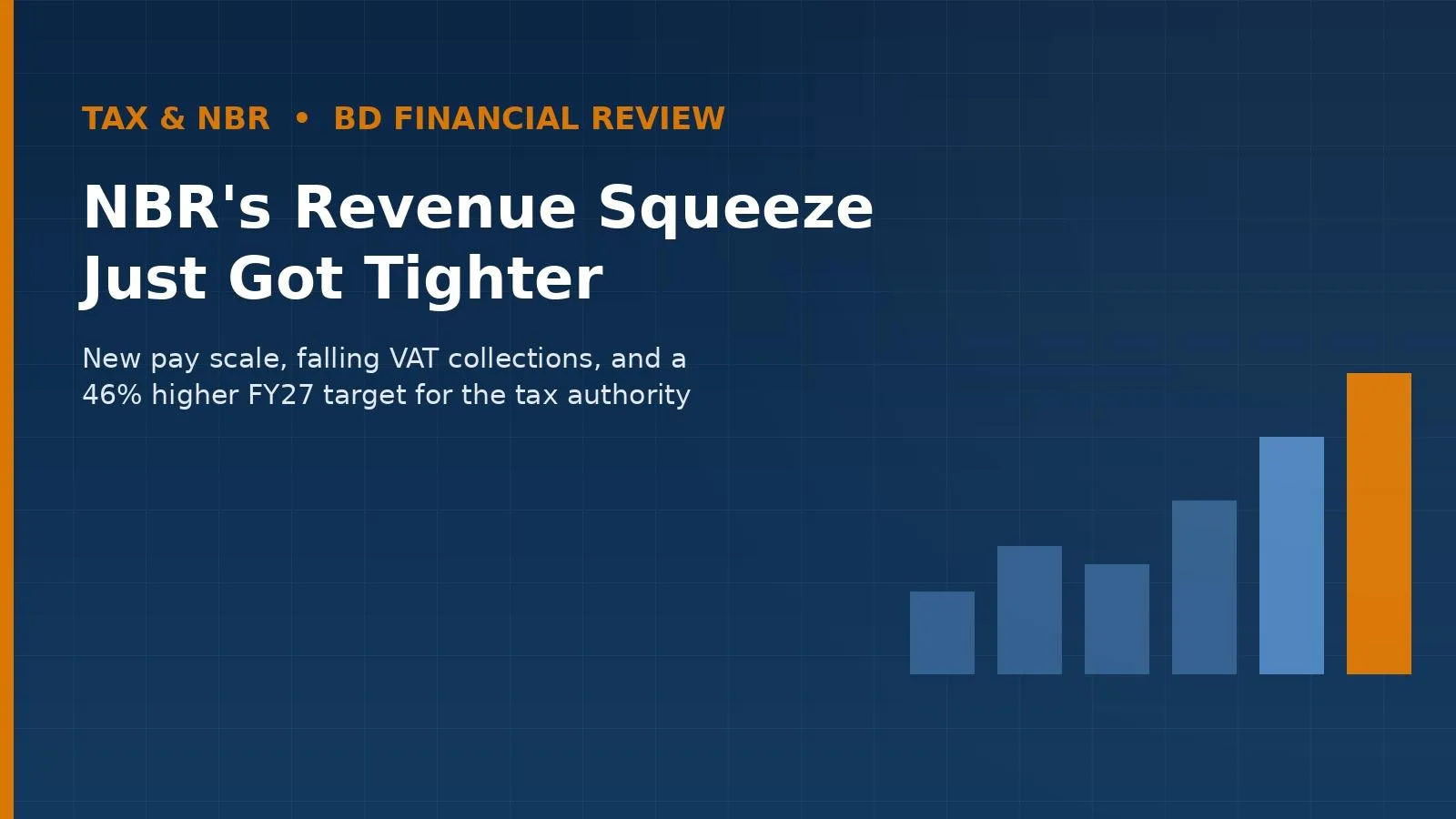
NBR Now Has to Fund the New Pay Scale Too , And Its Revenue Is Falling, Not Rising

Just days after bdfinancialreview.com reported NBR's Tk88,000 crore FY26 shortfall and its ambitious FY27 target, a new complication has emerged: the government is leaning on NBR to fund a Tk1.06 lakh crore annual pay scale hike for roughly 24 lakh employees and 9 lakh pensioners. The catch , VAT collections actually fell year-on-year in both July and August, making the 46% higher target look further out of reach, not closer.

September 2, 2026Read more

NBR's Tk88,000 Crore Shortfall and Its Bold Tk6.04 Lakh Crore Target for the Year Ahead

The National Board of Revenue missed its FY26 target by roughly Tk88,000 crore even after 12 percent growth, and its former chairman has just been sent to Washington as Bangladesh's alternate executive director at the World Bank. Meanwhile, NBR is chasing a 20 percent higher target this year. Here is what the numbers mean for taxpayers, and why the gap keeps widening.

August 30, 2026Read more