NBR's Tk88,000 Crore Shortfall and Its Bold Tk6.04 Lakh Crore Target for the Year Ahead
The National Board of Revenue missed its FY26 target by roughly Tk88,000 crore even after 12 percent growth, and its former chairman has just been sent to Washington as Bangladesh's alternate executive director at the World Bank. Meanwhile, NBR is chasing a 20 percent higher target this year. Here is what the numbers mean for taxpayers, and why the gap keeps widening.
A Familiar Story: Big Growth, Bigger Gap
The National Board of Revenue closed the 2025-26 fiscal year having collected roughly Tk4,15,000 crore against a target of Tk5,03,000 crore, a shortfall of about Tk88,000 crore, according to preliminary figures released in early July 2026. On its own, the 12-percent-plus growth over FY25 collections looks respectable. Set against the government's own target, it is the latest instalment in a now-familiar pattern: NBR consistently grows its collection year over year, and just as consistently falls well short of what the budget assumed it would raise.
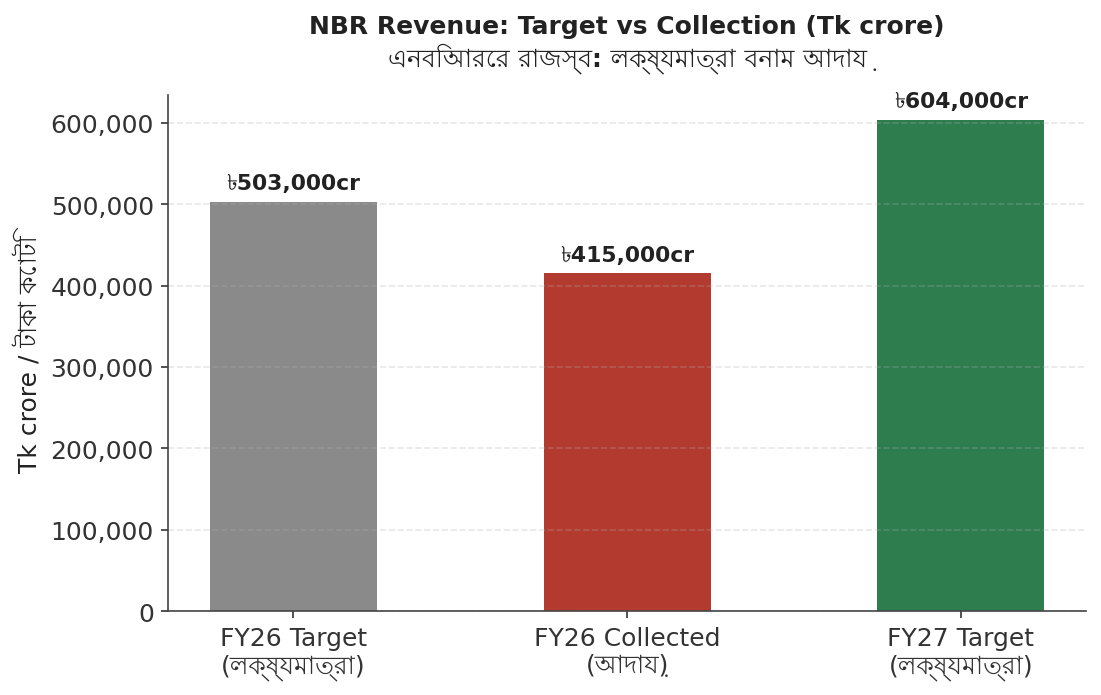
NBR revenue: FY26 target vs actual collection, and the FY27 target, in Tk crore. Source: NBR / media reports.
That gap matters well beyond an accounting exercise. Every taka of shortfall against the budgeted target has to be covered through some combination of higher borrowing, delayed government spending, or dipping into reserves earmarked for development projects, which is one reason infrastructure and social-programme budgets tend to face in-year cuts or slower disbursement whenever revenue collection disappoints.
The Even Bigger Ask for FY27
Rather than easing the target to something more achievable, the government has gone the other way: NBR's revenue target for the 2026-27 fiscal year has been set at Tk6,04,000 crore, a 20.07 percent jump over the FY26 revised budget of Tk 5,03,000 crore. Behind that number sits an even more ambitious structural goal — raising the tax-to-GDP ratio from 6.8 percent to 9.2 percent within the year, a jump that tax administrations elsewhere in the world typically take several years to achieve, if they manage it at all.
The strategy for getting there leans heavily on widening the tax base rather than simply raising rates on existing payers. NBR currently counts about 1.28 crore registered income taxpayers, but fewer than 8 lakh active VAT payers, a gap officials have flagged repeatedly as evidence of how much economic activity sits outside the formal tax net, particularly in retail, services and informal-sector trade.
A Chairman Departs for Washington
Adding a layer of institutional uncertainty to this stretch target, Md Abdur Rahman Khan — NBR's chairman through much of this period of both strong growth and persistent shortfalls — was appointed on August 23, 2026 as Bangladesh's alternate executive director at the World Bank's Washington headquarters, a three-year contractual posting representing Bangladesh's constituency at the institution. Under the terms of the appointment, his post-retirement leave and related benefits are suspended and he must sever ties with other professional roles, strongly suggesting a full departure from NBR rather than a dual role. Official confirmation of his NBR successor had not been published at the time of writing.
What This Means If You Are a Taxpayer
A revenue authority under this much pressure to close a widening gap typically responds in a predictable set of ways: more aggressive enforcement and audits, particularly targeting sectors and individuals identified as under-reporting; continued digitisation of VAT and income tax filing to reduce leakage and make evasion harder to hide; and closer scrutiny of high-value transactions, property purchases and bank deposits that do not appear to match a taxpayer's declared income. None of this is exotic or unique to Bangladesh, but it does mean the coming year is a poor time to be casual about accurate, complete tax filing.
If you are a registered taxpayer, expect continued pressure to file and pay through NBR's online systems, with paper-based processes increasingly treated as the exception rather than the norm.
If your income has grown but your declared tax position has not changed proportionally, treat that mismatch as a genuine audit risk given NBR's stated focus on closing the base-widening gap, not just a theoretical concern.
Businesses and individuals with VAT registration thresholds close to the mandatory limit should assume closer monitoring this year, given how explicitly NBR has flagged the shortfall between income and VAT taxpayer counts.
Keep an eye on official NBR announcements for the FY27 finance act's specific rate and threshold changes, since a target this ambitious will very likely be accompanied by at least some rate adjustments beyond base-widening alone.
The Honest Outlook
Given that NBR has missed its target in essentially every recent fiscal year despite genuine collection growth, treating the Tk6,04,000 crore FY27 target as a hard ceiling on what will actually be collected would be optimistic. The more useful number for taxpayers and businesses to watch is not the target itself, but NBR's own mid-year progress reports and any announced policy measures — VAT rate changes, new withholding requirements, expanded TIN mandates — that typically follow when an in-year shortfall becomes apparent, usually surfacing around the January-February supplementary budget discussions.
Free calculators
All calculatorsEMI & loan calculator
Monthly installment, total interest and a full repayment schedule. Compare two loan offers side by side.
Zakat calculator
Work out your nisab status and the 2.5% zakat due on cash, gold, silver, savings and business assets.
FDR & DPS maturity calculator
Maturity amount for a fixed deposit or monthly deposit scheme, after compounding and source tax.
Read next

Bangladesh Gives Ministries an October 25 Deadline to Map Out the Fiscal Year Switch to April March
Bangladesh's Cabinet Division has told every ministry and its subordinate offices to submit, by October 25, a time bound plan for rewriting the laws, rules and systems that still assume a July to June fiscal year. The instruction is the first real test of the government's August decision to shift the fiscal year to April through March starting in 2028-29. A separate, smaller deadline change lands the same week, with the tax authority pushing back the VAT return filing date to October 25 as well.

Thirteen Years After the Bacchu Scandal, BASIC Bank Still Can't Climb Out of Its Bad Loan Hole
BASIC Bank's September 2026 figures show 64.49 percent of its loan book, or Tk8,153 crore, still classified as bad, more than thirteen years after the Sheikh Abdul Hye Bachchu era loan scam first came to light. The bank is sitting on a Tk5,148 crore capital shortfall and a Tk5,051 crore provisioning gap, and its top 20 defaulters alone owe Tk2,288 crore of which only about 2 percent has ever been recovered. Chairman Helal Ahmed Chowdhury says a turnaround is possible within three years if the bank gets Tk5,000 crore in low cost deposits, but BASIC's bad loan ratio remains far above the 32.78 percent average across Bangladesh's banking sector. The bank's struggles mirror a wider problem among the country's five state owned banks, whose combined non performing loans climbed by Tk6,304 crore in just the first half of this year.

NBR Misses VAT Targets in 85 Percent of Sectors as New BIN Mandate Squeezes Small Businesses
Newly released FY26 figures show 29 of 34 large taxpayer units missed their VAT collection targets, leaving a roughly Tk20,500 crore shortfall against a Tk108,000 crore goal even as officials now admit many targets were set without adequately considering economic conditions. At the same time, a 2012 statutory requirement for a Business Identification Number to open a bank account or secure a loan is being enforced in earnest, landing hardest on cottage, micro, small and medium enterprises that make up 99 percent of Bangladesh's 11.7 million economic units. NBR says neither banks nor its own officials can waive the BIN rule administratively, even as the Association of Bankers, Bangladesh has formally requested an exemption or phased rollout for the smallest businesses. Together the two tracks describe a revenue board falling short with large taxpayers able to resist while tightening its grip on businesses with the least capacity to comply quickly, a pattern tied to the government's own widening need to borrow from banks this quarter.