NBR Now Has to Fund the New Pay Scale Too , And Its Revenue Is Falling, Not Rising
Just days after bdfinancialreview.com reported NBR's Tk88,000 crore FY26 shortfall and its ambitious FY27 target, a new complication has emerged: the government is leaning on NBR to fund a Tk1.06 lakh crore annual pay scale hike for roughly 24 lakh employees and 9 lakh pensioners. The catch , VAT collections actually fell year-on-year in both July and August, making the 46% higher target look further out of reach, not closer.
Barely a week after this outlet reported that the National Board of Revenue had missed its FY26 collection target by roughly Tk88,000 crore , even after growing collections by 12% , a fresh complication has surfaced that makes the tax authority's already uphill FY27 target look steeper still. According to a report published today by The Business Standard, the government has decided that NBR will be the one footing the bill for the country's new public-sector pay scale, an annual expense of Tk1,05,580 crore, or roughly Tk1.06 lakh crore.
The new pay structure benefits about 24 lakh serving government employees and close to 9 lakh pensioners. It is, by any measure, a significant fiscal commitment, and someone has to pay for it. The government's answer is straightforward: NBR must collect more. That instruction sits behind the eye-catching FY27 revenue target of Tk6.04 lakh crore, which this site covered on August 30 as a 20% jump over the year's baseline expectations. Seen against FY26's actual collection of about Tk4.15 lakh crore, that target represents a 46% year-on-year increase , one of the steepest single-year jumps NBR has ever been asked to deliver.
This is not simply an updated number. It is a structural shift in what NBR's revenue target is actually for. Previously, the FY27 target could be read as an ambitious but conventional growth goal following a difficult year. Now it is explicitly tied to funding a specific, non-negotiable government payroll obligation. If NBR falls short, the shortfall does not just show up in an abstract fiscal deficit figure , it directly threatens the government's ability to pay the salaries and pensions it has already promised to millions of people.
Collections Are Moving in the Wrong Direction
What makes this pay-scale mandate especially uncomfortable for NBR is timing. The instruction to collect enough to cover the new payroll is landing at precisely the moment when actual monthly collections are sliding backward, not building momentum.
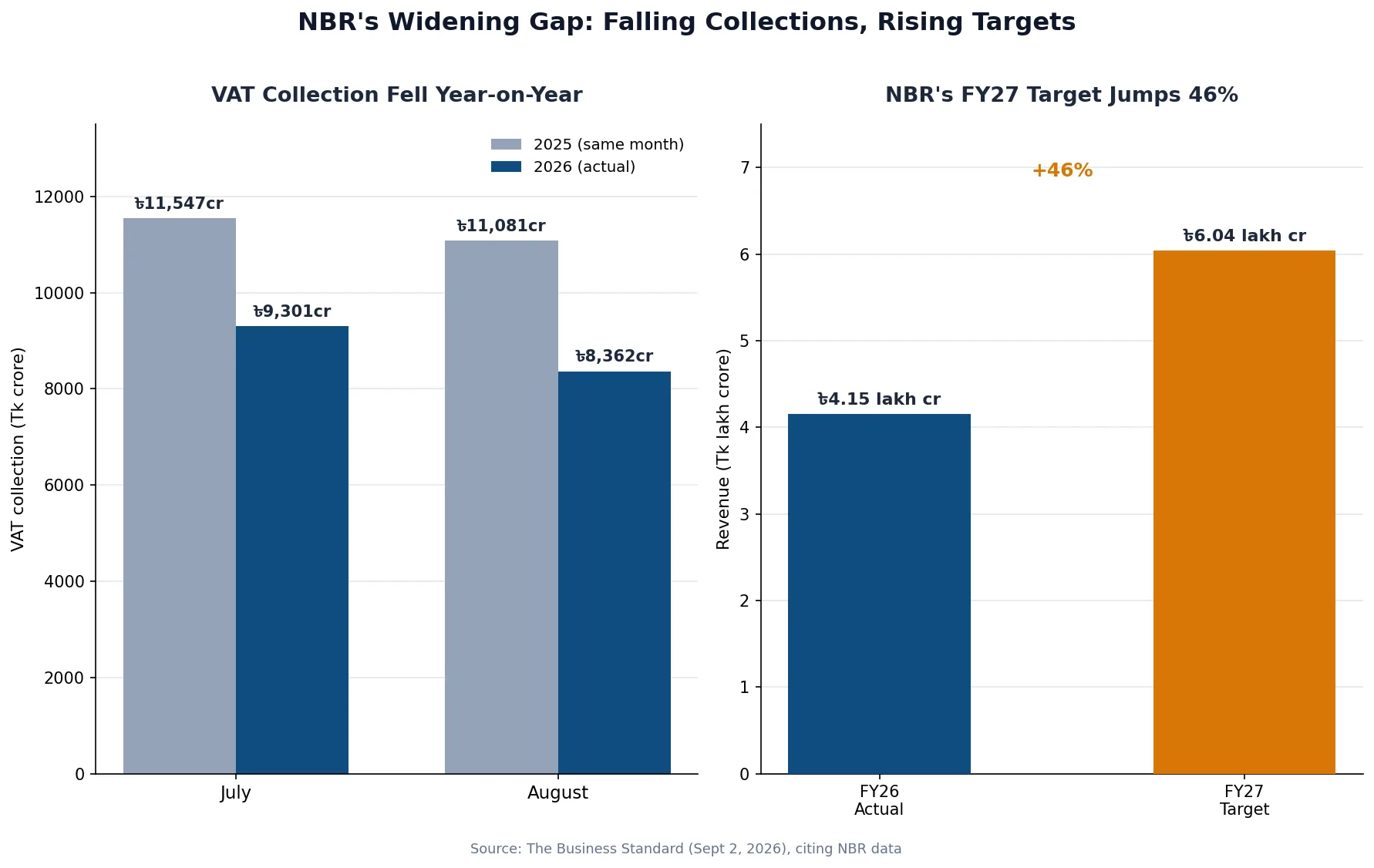
VAT collections fell year-on-year in both July and August even as NBR's FY27 target rose 46% above FY26's actual collection. Source: The Business Standard, Sept 2, 2026.
VAT collection , historically one of NBR's most reliable and largest single revenue streams , came in at Tk9,301 crore in July 2026, down sharply from Tk11,547 crore in the same month last year. August followed the same pattern: Tk8,362 crore this year against Tk11,081 crore in August 2025. That is a year-on-year decline of roughly 19% in July and about 25% in August. Two consecutive months of double-digit percentage decline is not noise; it is a trend, and it is happening in the very first two months of the fiscal year NBR is supposed to grow by 46%.
For context, VAT collection under Bangladesh's NBR tax revenue structure typically tracks fairly closely with domestic economic activity , consumption, manufacturing output, and imports all feed into it. When VAT falls even as the government raises its ambitions, it is a signal that the tax base itself is under strain, not that NBR is simply failing to collect what is already there.
Why the Money Isn't Coming In
The Business Standard's report cites several structural headwinds behind the decline, and none of them are quick fixes. Sluggish overall economic activity is dragging down the transaction volumes VAT depends on. Gas and power shortages have been disrupting industrial production in several sectors, which cuts directly into the output that generates VAT liability at the factory gate. Declining imports , partly a function of the same energy constraints and partly a reflection of businesses pulling back on capital spending , reduce the import-stage taxes and duties that make up a substantial share of NBR's total collection. And persistently high inflation is raising the cost of doing business, squeezing margins in a way that makes voluntary tax compliance harder to sustain even for otherwise willing taxpayers.
None of these are problems NBR can solve through better enforcement alone. An energy shortage is not a tax administration failure, and neither is an import slowdown driven by exchange-rate pressure or global demand conditions. Yet the instruction from the top, according to a senior NBR official quoted anonymously in the report, is nonetheless unambiguous: leadership has been told to "achieve the target at any cost."
That phrase is doing a lot of work. "At any cost" typically translates, in practice, into intensified field-level enforcement , more audits, tighter scrutiny of input-tax credit claims, faster movement on show-cause notices, and less patience for extensions or negotiated settlements. It can also mean political pressure trickling down through NBR's regional commissionerates to hit monthly and quarterly benchmarks regardless of the underlying economic conditions in a given district or sector.
What Economists Are Saying
Fahmida Khatun, the well-known Bangladeshi policy analyst, offered a blunt assessment of the situation in the same report. Her view is that NBR faces a genuine capacity gap rooted in structural weaknesses within the institution itself, and that this gap is compounded by an economic environment that simply is not conducive to hitting an ambitious revenue target right now. In other words, this is not purely a story about NBR needing to try harder. It is a story about an institution with real operational limits being asked to overperform at exactly the moment the broader economy is working against it.
That combination , institutional capacity constraints meeting a contracting revenue base meeting an urgent new spending obligation , is the kind of setup that tends to produce friction. Something has to give, and historically in similar situations, what gives first is the relationship between the tax authority and the businesses it audits.
What This Means for Taxpayers and Businesses
For compliant businesses already inside the tax net, the near-term implication is straightforward: expect more scrutiny, not less. When a revenue authority is under explicit pressure to hit a number that current economic conditions make difficult to reach organically, the natural response is to intensify collection from the base that is already easiest to reach , registered VAT payers, corporate taxpayers with clean filing histories, and import-stage collections at the customs level. Businesses should be prepared for more frequent audits, closer examination of VAT return filings, and less flexibility around payment timelines.
There is also a real possibility, though not yet confirmed in the source reporting, that NBR or the finance ministry could introduce new revenue measures during the fiscal year rather than waiting for the next budget cycle , supplementary duties, adjustments to VAT rates on specific goods or services, or tighter withholding tax provisions are all tools that have been used in the past when a mid-year gap opens up between target and reality. Nothing along these lines has been announced yet, and it is worth being precise about that: the source report does not specify what, if any, new tax measures NBR plans to introduce to close this gap. That remains an open question for future coverage.
For the broader business community, the risk is less about any single new rule and more about unpredictability. A tax authority operating under a mandate to hit an aggressive number "at any cost" is one where enforcement priorities can shift quickly and where the appetite for negotiated compliance , extensions, installment arrangements, amicable dispute resolution , tends to shrink. Companies with outstanding VAT or income tax matters before NBR should expect less room for delay than they might have had in a calmer fiscal year.
The Bigger Fiscal Picture
Step back, and the pattern connects directly to what this site has already reported. The FY26 shortfall of roughly Tk88,000 crore was, on its own, a story about a tax authority struggling to keep pace with an ambitious plan despite genuine 12% growth in collections. The FY27 target of Tk6.04 lakh crore looked steep even before this latest reporting. What has changed with today's news is the stakes attached to that target. It is no longer simply a planning figure NBR is expected to work toward , it is now explicitly the mechanism by which the government intends to fund a Tk1.06 lakh crore annual commitment to millions of current and former public employees.
That raises the political and fiscal cost of falling short considerably. A revenue miss in a normal year produces budget deficit pressure that can be absorbed, financed through borrowing, or partially offset by expenditure adjustments elsewhere. A revenue miss that specifically undercuts the government's ability to deliver a pay raise it has already announced to 24 lakh employees and 9 lakh pensioners is a different kind of problem , one with direct political visibility and consequence.
What to Watch Next
The coming months should clarify several things worth tracking. First, whether the July-August VAT decline is a temporary dip tied to specific disruptions , the gas and power shortages, in particular, may ease , or the start of a longer structural slide that persists through the fiscal year. Second, whether NBR leadership responds to the "at any cost" mandate primarily through intensified enforcement of existing compliance obligations, or whether the finance ministry moves to introduce new revenue measures mid-year. Third, whether the capacity gap that Fahmida Khatun points to prompts any structural reform at NBR itself, separate from the annual target-setting exercise , something that has been discussed for years in Bangladesh's tax policy circles without much concrete movement.
For now, the headline fact is simple and worth restating plainly: NBR's FY27 target has effectively been redefined from an ambitious revenue goal into the government's primary funding mechanism for a major new payroll commitment, at precisely the moment its actual monthly collections are falling rather than rising. Whatever happens next in this story, it will not be a quiet fiscal year for Bangladesh's tax authority , or for the businesses and individuals who deal with it.
References
Free calculators
All calculatorsEMI & loan calculator
Monthly installment, total interest and a full repayment schedule. Compare two loan offers side by side.
Zakat calculator
Work out your nisab status and the 2.5% zakat due on cash, gold, silver, savings and business assets.
FDR & DPS maturity calculator
Maturity amount for a fixed deposit or monthly deposit scheme, after compounding and source tax.
Read next

Bangladesh Reverses Course on Quarterly VAT, Brings Back Monthly Returns
Bangladesh is scrapping its four-month-old quarterly VAT filing system and reverting to monthly returns after VAT collection fell about 21 percent in the new system's first two months. The National Board of Revenue says businesses were delaying payments until each quarter's end, starving the treasury of timely cash. Firms with an outstanding July-September return now have until October 25 to file without interest or penalty.

Bangladesh Gives Ministries an October 25 Deadline to Map Out the Fiscal Year Switch to April March
Bangladesh's Cabinet Division has told every ministry and its subordinate offices to submit, by October 25, a time bound plan for rewriting the laws, rules and systems that still assume a July to June fiscal year. The instruction is the first real test of the government's August decision to shift the fiscal year to April through March starting in 2028-29. A separate, smaller deadline change lands the same week, with the tax authority pushing back the VAT return filing date to October 25 as well.

Thirteen Years After the Bacchu Scandal, BASIC Bank Still Can't Climb Out of Its Bad Loan Hole
BASIC Bank's September 2026 figures show 64.49 percent of its loan book, or Tk8,153 crore, still classified as bad, more than thirteen years after the Sheikh Abdul Hye Bachchu era loan scam first came to light. The bank is sitting on a Tk5,148 crore capital shortfall and a Tk5,051 crore provisioning gap, and its top 20 defaulters alone owe Tk2,288 crore of which only about 2 percent has ever been recovered. Chairman Helal Ahmed Chowdhury says a turnaround is possible within three years if the bank gets Tk5,000 crore in low cost deposits, but BASIC's bad loan ratio remains far above the 32.78 percent average across Bangladesh's banking sector. The bank's struggles mirror a wider problem among the country's five state owned banks, whose combined non performing loans climbed by Tk6,304 crore in just the first half of this year.