Dhaka Stocks Extend Rebound to a Second Day as Bargain Hunters Push DSEX Past 5,660
Two trading sessions after touching a two-month low, the Dhaka Stock Exchange's benchmark DSEX climbed for a second straight day on September 2, adding 23 points to close at 5,660. Turnover jumped 22.5 percent as investors hunted for bargains in beaten-down textile, insurance, and pharma stocks, though analysts caution the broader mood remains cautious.
Just two trading sessions ago, the Dhaka Stock Exchange was closing out its worst stretch in months, with the benchmark DSEX index sliding for thirteen consecutive sessions to finish at 5,598 points, a two-month low that had investors nervously watching their portfolios shrink day after day. That losing streak has now given way to something the market has not seen in a while: back-to-back gains. On September 2, the DSEX rose 23 points, or 0.41 percent, to close at 5,660, building on the previous session's 39-point recovery and marking the second consecutive day the index has moved higher.
The broader mood in the trading floor was notably livelier than it had been during the long slide. Turnover, the total value of shares changing hands during the day, jumped 22.5 percent to Tk 731 crore, a clear signal that more money was actively moving through the market rather than sitting on the sidelines. Of the 395 issues that traded during the session, 239 advanced, 92 declined, and 57 closed unchanged, meaning gainers outnumbered losers by well over two to one, a breadth reading that traders generally read as a healthy sign rather than a narrow rally confined to a handful of large-cap names.
The day's trading was not a straight line upward, though. The index opened near an intraday peak of 5,673 points before slipping back to around 5,644 in the mid-morning session, a dip that likely rattled some short-term traders before buyers stepped back in and pushed the index to its closing level. That kind of midday wobble followed by a recovery is often taken as evidence that the rally has some conviction behind it rather than being purely a one-way, low-volume bounce.
For context, it helps to remember what a 13-session losing streak actually represents for the ordinary investor. The Dhaka bourse has roughly 250 trading days in a year, so thirteen consecutive red sessions means nearly a full trading month where the index never once closed higher than the day before, an unusually long and psychologically grinding stretch even for a market accustomed to volatility. Retail investors who held on through that entire slide, rather than selling into the panic, are the ones best positioned to benefit from the current rebound, while those who exited near the bottom around 5,598 have effectively locked in losses just before the turnaround began, a pattern market veterans in Dhaka say repeats itself often enough that it has become something of a standing lesson for newer participants in the market.
Two other indices on the exchange told a similar story. The DSES, which tracks Shariah-compliant stocks, advanced 4.70 points, or 0.42 percent, to 1,135.12, moving in almost exact lockstep with the broader benchmark. The DS30, made up of the thirty largest and most liquid companies on the exchange, gained a more modest 3.45 points, or 0.16 percent, to close at 2,125.49, suggesting the rally was somewhat broader-based and not led purely by the exchange's biggest names.
Sector by sector, the textile industry dominated the day's activity, accounting for 39.5 percent of total turnover and posting returns of about 2 percent. That is a notable share for a single sector and reflects how heavily represented textile and garment-linked companies are on the Dhaka bourse, given the sector's outsized role in the broader Bangladeshi economy. General insurance stocks were the second most actively traded group, making up 13.1 percent of turnover with a slightly stronger 2.3 percent gain, while pharmaceutical shares rounded out the top three sectors with 10.3 percent of turnover.
Analysts at EBL Securities, one of the more closely watched brokerage research desks in Dhaka, characterized the buying as opportunistic rather than a fundamental shift in sentiment. Investors, the firm noted, sustained broad-based bargain hunting by accumulating beaten-down scrips at what they judged to be attractive price levels after the recent slide had pushed valuations down across a wide range of stocks. That framing matters, because it suggests the rally is being driven less by fresh optimism about corporate earnings or the macroeconomic backdrop, and more by investors who felt the market had simply fallen further than the fundamentals warranted and decided to step in while prices were low.
That caution is worth taking seriously given the backdrop the market has been trading against for much of the year. Inflation has remained stubbornly close to double digits, the taka has faced periodic pressure, and depositors have watched real returns on bank savings turn negative as deposit rates have fallen faster than prices. Corporate earnings across several sectors have also come under pressure from higher input costs and softer domestic demand. None of those underlying conditions changed meaningfully between the thirteen-session slide and this two-day recovery, which is exactly why analysts are framing the bounce as a tactical bargain-hunting move rather than the start of a sustained bull run.
For retail investors who have watched their portfolio values erode over recent weeks, the psychological relief of two green days in a row is real, even if it comes with the caveat that markets rarely move in a straight line in either direction. Whether this recovery has legs will likely become clearer over the coming week, as investors watch whether turnover stays elevated and whether the gains broaden further beyond the three sectors that dominated Wednesday's session. A retreat back toward the recent lows would suggest this was little more than a technical bounce, while a third or fourth consecutive day of gains, especially on strong turnover, would start to look like the beginning of a more durable turnaround. For now, market watchers in Motijheel are simply relieved to see green on the board again after a stretch that tested the patience of even long-term investors. Investors weighing whether to enter now or wait would do well to track turnover figures over the next few sessions specifically, since sustained volume above the roughly Tk 600 to 700 crore range that has become typical this year would be a stronger signal of genuine conviction than the point movement in the index alone.
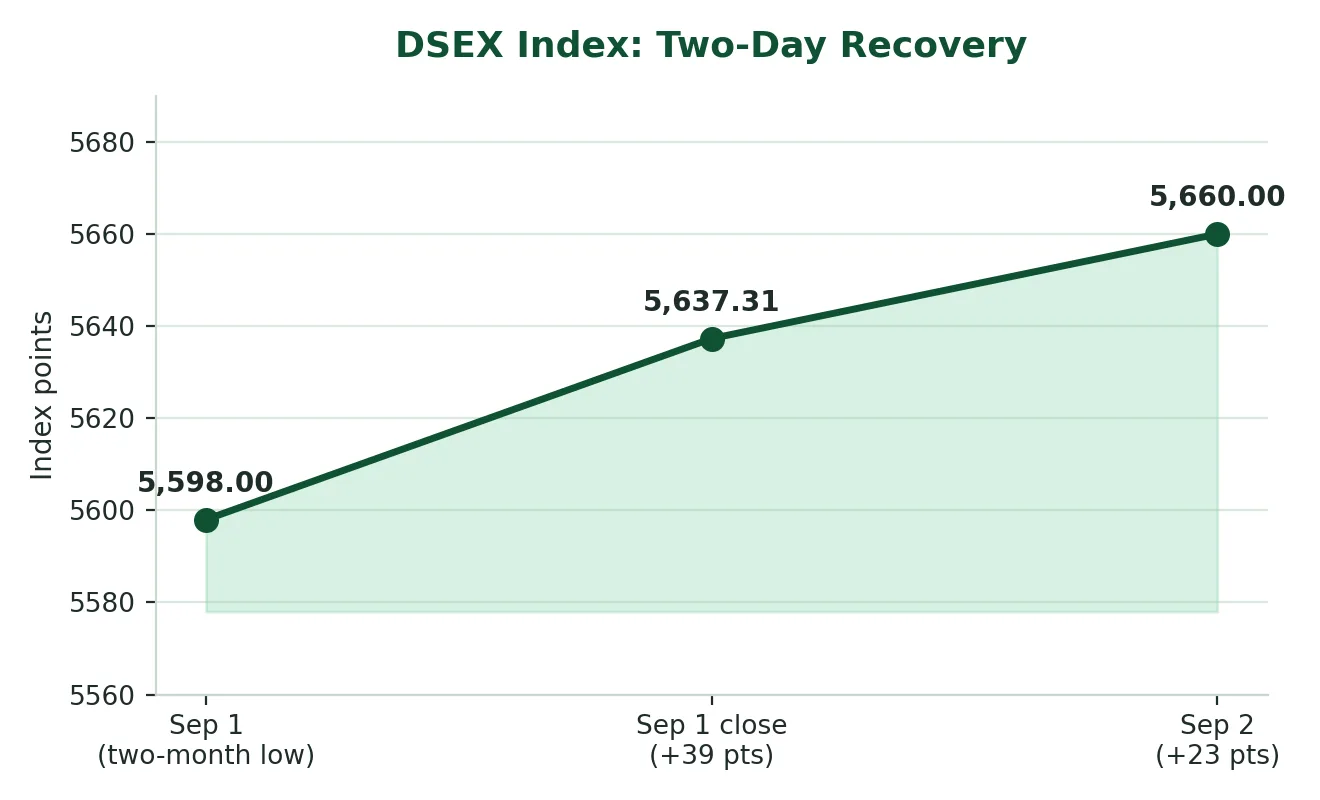
DSEX Index: Two-Day Recovery After a Two-Month Low
References
Free calculators
All calculatorsEMI & loan calculator
Monthly installment, total interest and a full repayment schedule. Compare two loan offers side by side.
Zakat calculator
Work out your nisab status and the 2.5% zakat due on cash, gold, silver, savings and business assets.
FDR & DPS maturity calculator
Maturity amount for a fixed deposit or monthly deposit scheme, after compounding and source tax.
Read next

BSEC Doubles Direct Listing Threshold, Plans Dutch Auctions to Fix Bangladesh's IPO Drought
Bangladesh's stock market regulator has laid out a package of reforms meant to pull large family owned and multinational firms onto the exchange, including a Dutch auction pricing system for new listings and a doubled threshold for direct listing eligibility. The market still relies on banks for three quarters of corporate financing, and regulators want that to change.

BSEC Revives Bangladesh's Tk1,700 Crore Investor Fund After a 26-Month Board Vacuum
Bangladesh's Capital Market Stabilisation Fund went 26 months without a governing board, until the securities regulator finally named a new seven member interim panel this week. The fund, worth about Tk1,700 crore in unclaimed dividends and stocks, is meant to protect small investors, but a legal dispute over whether Bangladesh Bank should control it left the whole structure frozen since 2024. BSEC now wants a dedicated law to settle the question for good, with a draft expected to reach parliament soon.

BSEC Tightens Dividend Deposit Rules After Non Compliance, Eases Independent Director Reappointments
The Bangladesh Securities and Exchange Commission has ruled that no listed company can present a cash dividend proposal at its AGM unless the full amount is already deposited in a separate bank account and certified. The move follows recent cases of non-compliance and comes with a warning of punitive action. In the same meeting, the regulator eased the approval process for reappointing independent directors, requiring only a clean credit report rather than a fresh review each time.