DSEX Rally Snaps as Profit-Taking Erases a Three-Session Winning Streak
Dhaka's benchmark index opened Wednesday on the same bargain-hunting momentum that had carried it higher for two straight sessions. By the closing bell it had slipped 1.67 points to 5,662.09, as investors locked in gains and turnover eased. Cement and life insurance stocks held up best while textiles led the retreat.
The Dhaka Stock Exchange's benchmark index spent Wednesday morning looking like it might extend a rally that had already carried it past the psychologically important 5,660 mark. By the time trading closed, that momentum had faded. The DSEX finished the session down 1.67 points at 5,662.09, a modest slip that nonetheless ended a three-session winning streak that had drawn bargain hunters back into a market still finding its footing after a difficult stretch earlier in the year.
The reversal was not dramatic in points terms, but it marked a clear change in tone from the two previous sessions, when investors had pushed the index higher on renewed confidence and a wave of buying in undervalued shares. Turnover told a similar story of cooling enthusiasm: Tk 721 crore changed hands on Wednesday, down 1.4 percent from Tk 731 crore in the previous session. Market breadth confirmed the shift as well. Of the 395 securities traded, 225 declined, only 125 advanced, and 45 closed unchanged, a ratio that left little doubt sellers had the upper hand by the close.
According to EBL Securities, the pullback reflected a lack of strong conviction among investors over where the market goes next, which prompted quick profit-taking that limited how far the earlier rally could run. Selling pressure built through the afternoon session, the brokerage noted, as traders who had bought in on the earlier upswing chose to bank their gains rather than hold on for a fourth consecutive day of advances. That kind of behaviour is typical after a sharp short-term rally in a market like Dhaka's, where liquidity remains thinner than in larger regional exchanges and where sentiment can flip quickly once early movers start locking in profits.
It is worth remembering what the DSEX actually measures. The index tracks the broad market across the roughly 390 to 400 companies that trade on the Dhaka Stock Exchange on any given day, making it the most widely cited gauge of sentiment even though narrower indices, such as the blue-chip DS30, sometimes tell a different story on the same trading day depending on how the largest, most liquid names perform relative to smaller and mid-cap stocks. A broad-based pullback like Wednesday's, spread fairly evenly across sectors rather than concentrated in one index-heavy name, tends to be the more reliable read on genuine investor sentiment than a move driven by a single large-cap stock swinging the headline number.
Not every corner of the market moved the same way, and the sector-by-sector picture is arguably more informative than the headline index figure. Cement stocks led the gainers, adding 1.8 percent on the day, followed by life insurance issues at 1.7 percent and information technology shares at 1 percent. Analysts covering the cement sector have pointed to steady infrastructure-linked demand and relatively resilient input-cost management as reasons the sector has held up better than the broader market in recent sessions, though Wednesday's gain should be read as one day's data rather than a durable trend on its own.
On the losing side, textile stocks fell hardest, down 2.4 percent, with mutual funds close behind at a 1.4 percent decline and services shares off 1.1 percent. The textile sector's weakness is worth watching closely in the weeks ahead given how central ready-made garment exports are to Bangladesh's foreign exchange earnings; a sustained pullback in listed textile names can sometimes, though not always, mirror broader concerns about export demand or input costs facing the sector.
For retail investors trying to make sense of a single volatile session, the more useful signal may be the shift in market breadth rather than the size of the index move itself. A three-to-one ratio of decliners to advancers, even alongside a small headline decline, suggests the retreat was broad-based rather than concentrated in one or two heavily weighted stocks dragging the whole index down. That broad participation, both on the way up over the prior two sessions and on the way down Wednesday, points to a market currently being driven more by short-term positioning among active traders than by any single piece of company-specific news.
The composition of Wednesday's selling also matters for how the coming sessions might unfold. When a pullback is driven mainly by retail investors and day traders locking in short-term gains, as brokers describe this one, the market often stabilises within a session or two once the most impatient sellers have exited their positions. That differs from a pullback driven by larger institutional outflows or foreign portfolio investors reducing exposure, which tends to weigh on prices for longer and shows up as sustained selling pressure across multiple sessions rather than a single-day dip followed by renewed buying interest. Wednesday's pattern, a strong open followed by afternoon profit-taking, is more consistent with the former than the latter, though a single day of trading data is rarely enough to draw firm conclusions about which type of investor is driving the market.
The DSEX's recent path illustrates a pattern that has become familiar to Dhaka market watchers this year: sharp, multi-day rallies built on bargain hunting, followed by equally sharp pauses as profit-taking sets in once prices approach levels investors consider fair value again. Turnover in the Tk 700 to Tk 750 crore range, where Wednesday's session landed, remains well within what brokers describe as a normal, moderately active trading day for the exchange, neither signalling panic selling nor the kind of surge in participation that would suggest a durable change in market direction.
For retail investors who entered the market during the two-session rally, brokers generally advise resisting the urge to read too much into a single down day, whether that means panic selling out of positions bought just days earlier or, conversely, aggressively buying the dip on the assumption the rally must resume immediately. A more measured approach, tracking whether turnover and breadth stabilise over the next two or three sessions rather than reacting to any single day's close, tends to serve retail participants better in a market where sentiment has shown it can swing sharply within short windows. Investors focused on specific sectors, cement and life insurance among Wednesday's stronger performers, may also want to look at whether the sector-level strength holds up over a full week rather than basing decisions on one session's gains.
Whether Wednesday's pause becomes the start of a longer consolidation or simply a one-day breather before the rally resumes will likely depend on factors outside the exchange itself, including the trajectory of inflation, the central bank's next moves on interest rates, and how upcoming corporate earnings reports land with investors already primed to take profits at the first sign of weakness. For now, market participants appear to be treating the small decline as routine housekeeping after a good run rather than the start of a deeper correction, though sentiment in a market this size can shift again within a single trading session.
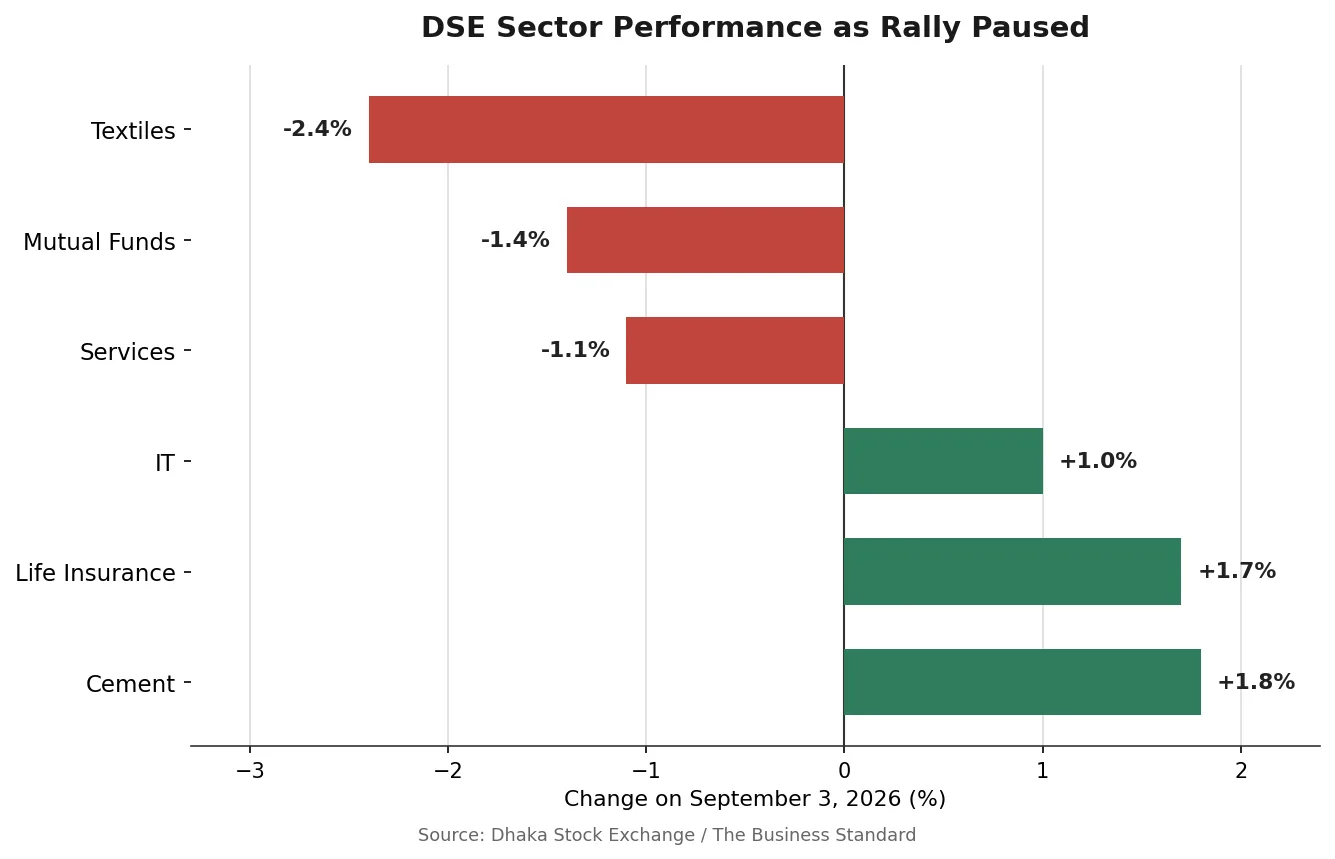
DSE sector performance, September 3, 2026. Source: Dhaka Stock Exchange.
References
Free calculators
All calculatorsEMI & loan calculator
Monthly installment, total interest and a full repayment schedule. Compare two loan offers side by side.
Zakat calculator
Work out your nisab status and the 2.5% zakat due on cash, gold, silver, savings and business assets.
FDR & DPS maturity calculator
Maturity amount for a fixed deposit or monthly deposit scheme, after compounding and source tax.
Read next

Dhaka Stocks Slip to 5,422 as Textiles Dominate a Subdued Session
The DSEX benchmark fell 10 points to 5,422 on Sunday, October 18, its second straight losing session, as turnover shrank to a subdued Tk365 crore. Textiles alone accounted for 23% of trading, and a DSE official pointed to a scheduled technical test as part of the reason volumes were so thin.

BSEC Doubles Direct Listing Threshold, Plans Dutch Auctions to Fix Bangladesh's IPO Drought
Bangladesh's stock market regulator has laid out a package of reforms meant to pull large family owned and multinational firms onto the exchange, including a Dutch auction pricing system for new listings and a doubled threshold for direct listing eligibility. The market still relies on banks for three quarters of corporate financing, and regulators want that to change.

BSEC Revives Bangladesh's Tk1,700 Crore Investor Fund After a 26-Month Board Vacuum
Bangladesh's Capital Market Stabilisation Fund went 26 months without a governing board, until the securities regulator finally named a new seven member interim panel this week. The fund, worth about Tk1,700 crore in unclaimed dividends and stocks, is meant to protect small investors, but a legal dispute over whether Bangladesh Bank should control it left the whole structure frozen since 2024. BSEC now wants a dedicated law to settle the question for good, with a draft expected to reach parliament soon.