DSEX Slides to Two-Month Low After 13 Straight Losing Sessions
Dhaka's benchmark DSEX index has now fallen for 13 consecutive trading sessions, shedding nearly 5% to close at 5,598 points on August 31 i,s weakest level in roughly two months. Thin turnover and a darkening mood on the trading floor point to a market waiting for clarity on Bangladesh's energy crisis, even as remittances and foreign exchange reserves tell a brighter story elsewhere in the economy.
The Dhaka Stock Exchange closed out August in retreat, with the benchmark DSEX index falling for a thirteenth consecutive session on August 31 to settle at 5,598 points. The index has now shed 306 points, or nearly 5%, since the losing streak began, dragging the market to its lowest level in roughly two months and marking the first close below the 5,600 mark since late June or early July.
For a market that had shown flickers of resilience earlier in the year, the length of the slide has unsettled investors more than any single day's loss. Thirteen straight sessions in the red is an unusually long stretch even by the standards of a bourse accustomed to volatile swings, and it has revived familiar questions about what it will take to restore confidence on Motijheel's trading floor.
A Weak Close to a Rough Week
The final session of August capped a week that was already bearish. Over the five trading days from August 24 to August 29, the DSEX dropped 130 points, or 2.25%, to close the week at 5,656 , down from 5,786 the week before. The blue-chip DS30 index, which tracks the exchange's most liquid and heavily capitalised companies, fell in tandem, closing the week at 2,113 points against 2,162 a week earlier.
Market breadth told the same story in sharper relief. On August 29 alone, 342 issues on the Dhaka bourse closed lower against just 35 that advanced, a ratio that left little doubt about where sentiment stood. Large-cap names carried an outsized share of the blame: Islami Bank, Pubali Bank and Sharp Industries were among the heavyweight decliners whose combined weight helped drag the broader index down further.
That kind of decline in the DS30 matters beyond the headline number. Because the index is built from the exchange's most liquid, most heavily traded companies, a fall of that magnitude signals that institutional and high-net-worth investors , the participants most likely to hold blue-chip positions , have been trimming exposure alongside retail traders rather than stepping in to buy the dip. When both ends of the investor base retreat at once, a slide tends to feed on itself: falling prices discourage new buyers, which in turn keeps volumes low and prices under pressure.
Turnover Tells Its Own Story
Perhaps the more telling signal has come from trading volumes rather than the index itself. Daily turnover on the DSE has collapsed by 61% since the start of August, sliding from Tk1,211 crore on August 4 to just Tk477 crore on August 31. A market that trades less is a market where investors are choosing to sit on the sidelines rather than commit fresh capital , a pattern that typically deepens a downturn rather than arresting it, since thinner volumes make the index more susceptible to sharp swings on relatively small trades.
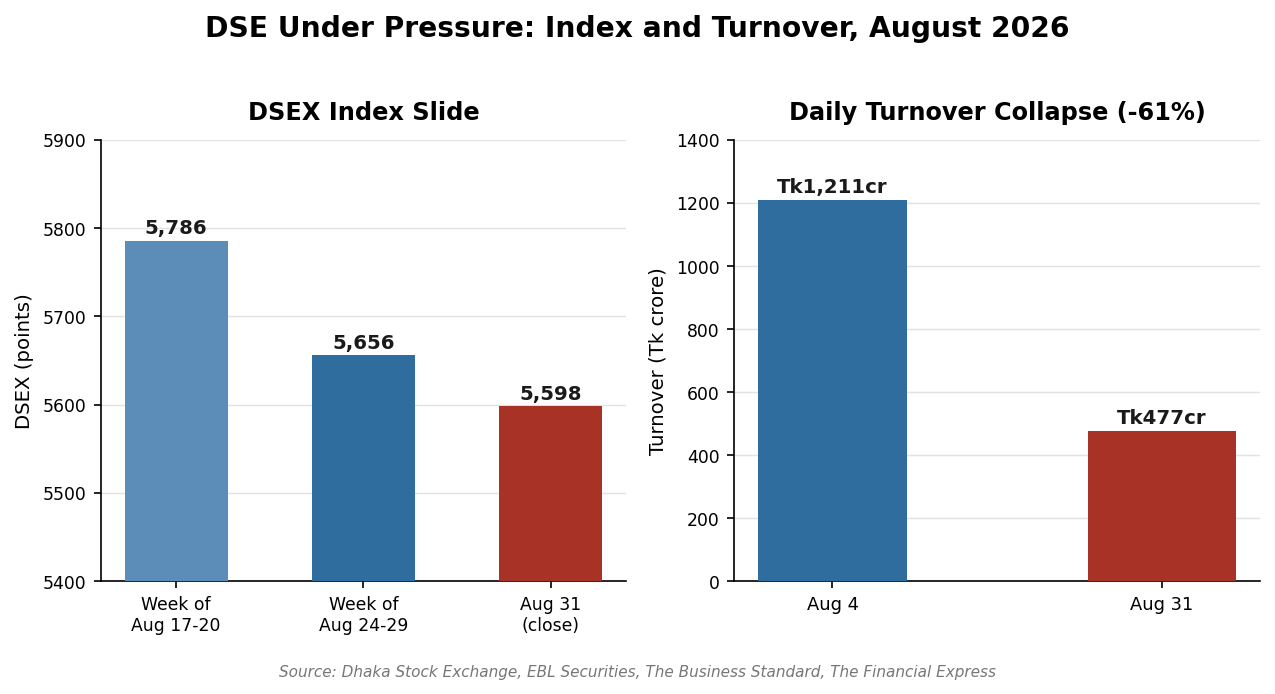
DSEX weekly close and daily turnover, August 2026.
What's Driving the Sell-off
Brokerage analysts point to a mix of factors weighing on the market. EBL Securities has flagged weak fresh fund inflows as a persistent drag, with few new investors or institutions stepping in to absorb selling pressure. Heightened regulatory scrutiny from the Bangladesh Securities and Exchange Commission (BSEC) targeting market manipulators has also made some traders more cautious, even if the crackdown is broadly seen as necessary for the market's long-term health.
A more mechanical factor has also played a role: United Commercial Bank's Tk775 crore rights issue has absorbed a meaningful slice of the liquidity that might otherwise have flowed into secondary-market trading. Rights issues of that size are not unusual on the DSE, but their timing this year has coincided with an already cash-strained market, compounding the turnover squeeze.
The Energy Crisis Looms Largest
None of those factors, however, appears to be the primary driver. Market participants and analysts alike keep returning to the same underlying concern: Bangladesh's unresolved gas and electricity crisis, which continues to disrupt factory operations, raise production costs, and cloud the earnings outlook for listed industrial and manufacturing companies.
That concern was reinforced in blunt terms by the government itself. On August 16, Finance and Planning Minister Amir Khosru Mahmud Chowdhury told reporters that the power and gas crisis “cannot be solved within six months. No solution is possible within a year either. It will take at least two years.” He added a warning that has since been widely quoted in market commentary: “Without gas and electricity, the economy cannot move forward.”
For a stock market whose largest sectors include textiles, pharmaceuticals, cement and other energy-intensive manufacturing, a minister's public acknowledgment that relief is at least two years away is not a minor data point , it is a signal that near-term earnings pressure on industrial issuers is likely to persist well into 2027 and beyond. That timeline helps explain why the sell-off has been broad-based rather than confined to a handful of stocks, and why fresh money has been slow to return even as valuations on some counters have become more attractive on paper.
A Contrasting Picture: Remittances and Reserves Climb
The gloom on the trading floor stands in contrast to a notably brighter trend elsewhere in the economy. Workers' remittances reached $2.34 billion in the first 24 days of August 2026, up 25.7% from the $1.861 billion recorded over the same period last year. For the current fiscal year to date , July 1 through August 24, FY2026-27 , remittance inflows total $5.198 billion, a 19.8% increase year-on-year.
That steady stream of inward remittances has fed directly into the country's foreign exchange position. Bangladesh Bank data show gross foreign exchange reserves climbing to $37.47 billion as of August 24, 2026, up from $36.42 billion in July. Under the IMF's stricter BPM6 methodology, which excludes certain assets not readily available for external payments, reserves stood at $32.62 billion , still a meaningfully improved cushion compared with earlier in the year.
It is important to be clear that this is a separate story from the stock market's slide, not a sign of an imminent turnaround for equities. Remittance inflows and reserve accumulation reflect the external sector and household transfers from overseas workers; they do not by themselves resolve the gas and power shortages weighing on industrial output, nor do they directly address the thin trading volumes and cautious sentiment on the DSE. But taken together, the two trends offer investors a fuller picture of an economy that is simultaneously under strain in one area and gaining ground in another.
What Analysts Are Watching Next
For now, market watchers say the DSEX is likely to stay under pressure until there is either a credible near-term plan to ease the energy crunch or a fresh catalyst , such as improved corporate earnings, new institutional inflows, or clearer BSEC guidance , that can draw hesitant investors back into the market. With the finance minister himself setting expectations for a multi-year fix rather than a quick one, brokers say the more realistic near-term hope is stabilisation rather than a sharp rebound: fewer red days, steadier turnover, and a market that stops testing new lows even if it does not immediately reclaim the ground lost since early August.
Whether that stabilisation arrives in September will depend heavily on signals from Dhaka's policymakers in the coming weeks, as well as on whether the broader macroeconomic tailwinds , a strengthening remittance flow and a healthier reserve position , eventually translate into greater confidence on the trading floor itself.
In the meantime, the two-year timeline laid out by the finance minister leaves little room for the market to simply wait out the problem. Listed manufacturers reliant on steady gas supply and uninterrupted power are likely to keep flagging higher input costs and production disruptions in their upcoming quarterly disclosures, and investors will be watching those earnings releases closely for early signs of how individual companies are coping. Until the energy picture becomes less uncertain, most analysts expect the DSEX to trade in a cautious, narrow range, with any rally likely to be tested quickly by profit-taking rather than sustained by fresh conviction.
References
- 1Investors' confidence melts down as DSEX loses 306 points in 13 sessions | The Business Standard
- 2. DSEX sinks below 5,700 as energy crisis weighs on market sentiment | The Financial Express
- 3DSE starts week on bearish note as indices slide | The Business Standard
- 4Power, gas crisis may take at least 2 years to resolve: Khosru | The Business Standard
- 5Remittance inflow surges 25.7pc by August 24 | BSS
- 6Bangladesh's gross forex reserves rise to $37.47bn | BSS
Free calculators
All calculatorsEMI & loan calculator
Monthly installment, total interest and a full repayment schedule. Compare two loan offers side by side.
Zakat calculator
Work out your nisab status and the 2.5% zakat due on cash, gold, silver, savings and business assets.
FDR & DPS maturity calculator
Maturity amount for a fixed deposit or monthly deposit scheme, after compounding and source tax.
Read next

BSEC Revives Bangladesh's Tk1,700 Crore Investor Fund After a 26-Month Board Vacuum
Bangladesh's Capital Market Stabilisation Fund went 26 months without a governing board, until the securities regulator finally named a new seven member interim panel this week. The fund, worth about Tk1,700 crore in unclaimed dividends and stocks, is meant to protect small investors, but a legal dispute over whether Bangladesh Bank should control it left the whole structure frozen since 2024. BSEC now wants a dedicated law to settle the question for good, with a draft expected to reach parliament soon.

BSEC Tightens Dividend Deposit Rules After Non Compliance, Eases Independent Director Reappointments
The Bangladesh Securities and Exchange Commission has ruled that no listed company can present a cash dividend proposal at its AGM unless the full amount is already deposited in a separate bank account and certified. The move follows recent cases of non-compliance and comes with a warning of punitive action. In the same meeting, the regulator eased the approval process for reappointing independent directors, requiring only a clean credit report rather than a fresh review each time.

Bangladesh's Foreign Investment Inflows Drop 28 Percent in First Half of 2026, Equity Hit Hardest
Foreign investors sent 28 percent less money into Bangladesh in the first half of 2026 than a year earlier, Bangladesh Bank data show. Net equity capital inflows, widely seen as the clearest sign of fresh investor commitment, fell 55 percent to just $155 million. Economists point to energy shortages, trade disruptions and broader macroeconomic strain as the main reasons behind the slide.