Now You Can Buy a Smartphone With Just Your Mobile Balance , Here's What Changed
Bangladesh Bank and the telecom regulator BTRC have raised the spending limit on Direct Operator Billing by 150%, letting mobile users buy phones, routers and other services straight from their mobile balance. The monthly cap jumps from Tk2,000 to Tk5,000, and the yearly ceiling from Tk20,000 to Tk50,000 , the biggest increase since the service launched in 2018. For millions of Bangladeshis without a bank account or credit card, this quietly opens a new, everyday way to finance a smartphone.
Now You Can Buy a Smartphone With Just Your Mobile Balance , Here's What Changed
If you have ever topped up your phone and wondered why that balance could only be spent on calls, texts and data, that boundary just moved. Bangladesh Bank and the Bangladesh Telecommunication Regulatory Commission (BTRC) have raised the spending limit on Direct Operator Billing (DOB) by 150 percent, a change that lets ordinary mobile users buy a handset and pay for it in installments straight out of their mobile balance, no bank account or credit card required.
The new rule, reported by The Daily Star on September 2, 2026, pushes the monthly DOB spending cap from Tk2,000 to Tk5,000, and the annual ceiling from Tk20,000 to Tk50,000. It is the single largest jump the service has seen since it launched back in 2018, when the limits were a modest Tk600 a month and Tk3,000 a year. For a country where a large share of the adult population still has no formal bank relationship, this is a quiet but meaningful shift in how everyday Bangladeshis can access consumer credit.
What Direct Operator Billing actually is
Direct Operator Billing is the formal name for something most mobile users already do without thinking about it: paying for a digital purchase by deducting the cost from mobile balance instead of a bank card. Buy a ringtone, subscribe to a video app, or top up a game, and the charge often shows up as a balance deduction rather than a bank transaction. It works because your mobile operator effectively extends you a small, short-term line of trust tied to your SIM, then settles the charge against your balance or your next recharge.
Until now, that convenience was capped fairly low and, crucially, could not be used to buy a physical device like a smartphone. The mobile balance spending limit in Bangladesh applied mostly to digital content and services. The revised rules change that in one important way: smartphones, SIM-based devices and routers are now eligible purchases under DOB, and the higher ceiling is specifically designed to support installment payment plans funded through mobile balance rather than a one-time lump sum.
The numbers, in plain terms
It helps to see the scale of the increase side by side. When DOB launched in 2018, a user could spend at most Tk600 in a month and Tk3,000 across a year through their operator billing. That limit was raised over time and, until June 2026, stood at Tk2,000 a month and Tk20,000 a year. The change now in effect takes both figures up by 150 percent at once, to Tk5,000 a month and Tk50,000 a year.
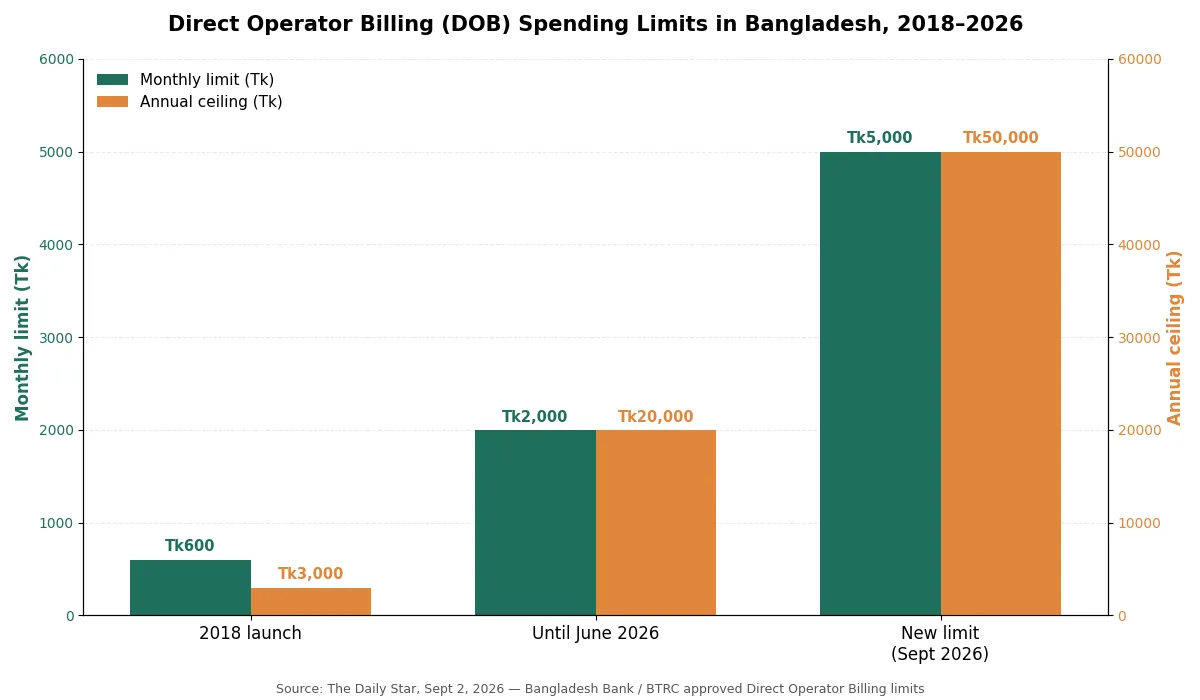
Chart: Direct Operator Billing (DOB) spending limits, 2018–2026
Put another way, a customer can now channel more than four times what was possible when the service first launched, and two and a half times what was allowed just a few months ago, entirely through the balance sitting on their SIM. For a mid-range smartphone priced somewhere between Tk15,000 and Tk25,000, a Tk5,000 monthly allowance means a phone could realistically be paid off in three to five months of installments, funded by mobile balance top-ups a person was likely making anyway.
Who this change is really for
The official reasoning behind the increase, according to BTRC and industry officials, centers on two goals: widening smartphone penetration and reaching people who fall outside the traditional banking and card system. Bangladesh's mobile financial services sector has grown rapidly over the past decade, but a meaningful share of the population, particularly in rural areas, still lacks a bank account, a debit card or a credit history that would qualify them for a formal consumer loan or an EMI plan from a retailer.
Grameenphone's chief corporate affairs officer summed up the intent plainly: the government is trying to increase smartphone penetration, and the new limit allows customers who do not have access to cards or other banking channels to purchase handsets using their mobile balance instead. In practice, that description points to a fairly specific set of beneficiaries , rural residents, gig and informal-sector workers who are paid in cash, students without an independent credit history, and anyone who has simply never opened a bank account but has, like nearly everyone else in the country, a working SIM card and a habit of recharging it.
For these groups, a smartphone is often the single device that determines whether they can access mobile banking apps like bKash and Nagad, government services, online marketplaces, remote work platforms or even basic internet banking. Removing the need for a card or an account just to finance that first or replacement device is, in a very direct sense, a financial inclusion tool as much as a telecom policy tweak.
How the installment buying is expected to work
The mechanics build on what Direct Operator Billing already does. Instead of paying a retailer or a bank in one lump sum, a customer buying a phone through an approved DOB partnership would have the cost split into installments that are deducted from their mobile balance over a period of months, up to the new monthly and annual caps. Every recharge a person makes effectively becomes a small repayment toward the device, without the paperwork, credit check or collateral typically associated with a bank loan or a retailer's EMI scheme.
This is not entirely new in spirit. Handset financing through operators, sometimes called bundled or subsidized device plans, exists in many markets. What is new here is the scale at which Bangladesh's regulators are now permitting it to happen purely through prepaid mobile balance, without requiring the customer to hold any banking product at all.
Only one operator is live so far
It is worth being precise about where things actually stand today. So far, only Grameenphone, the country's largest mobile operator, has received approval to operate under the revised, higher DOB ceiling. BTRC has signaled that other operators, such as Robi, Banglalink and Teletalk, may apply for the same approval, but as of this writing none of them has been confirmed. If you are a subscriber on a different network, do not assume the higher limit already applies to your account, and check with your own operator before planning a purchase around it.
It is also worth noting that this is not a permanent rule change, at least not yet. Bangladesh Bank approved the new limits for a period of six months. The previous temporary increase, which had pushed the ceiling to Tk2,000 a month and Tk20,000 a year, had itself been in effect only until June 2026, before this fresh, larger increase replaced it. Whether the Tk5,000 and Tk50,000 limits become a lasting fixture or get revised again once the six-month window closes is not yet settled.
The part everyone should think about before using it
A higher spending limit is good news for access, but it is worth being honest about what Direct Operator Billing actually is: a form of consumer credit, just one that does not feel like credit because no bank statement, loan agreement or card bill shows up to remind you of it. The money comes out of a balance that many people mentally categorize as "phone credit" rather than "money I owe," which is exactly the kind of framing that makes it easy to overspend.
A few practical habits make the difference between DOB being a genuinely useful financing tool and becoming a source of quiet financial strain. Treat every DOB-funded purchase the same way you would treat any installment plan: know the total cost, know the number of installments, and know exactly when the last one falls due. Keep a mental or written note of how much of your Tk5,000 monthly allowance is already committed to a device installment before you use the rest of your balance for anything else, since going over the monthly cap simply means the purchase or top-up will not go through. And because this spending does not show up in a bank passbook or a mobile banking app's transaction history the way a bKash or Nagad payment does, it is worth checking your operator's own balance and usage history regularly so a device installment does not quietly eat into money you needed for calls, data or emergencies.
There is also a simple math check worth doing before committing to any device financed this way: add up the full price of the phone across all its installments, and compare it with the phone's cash price if you saved up and paid for it outright, or with an EMI plan from a bank or retailer if you happen to qualify for one. Operator-financed installment plans are convenient, but convenience is not the same as being the cheapest option, and it is worth asking your operator or retailer directly whether any markup or service charge is built into the installment price.
Part of a bigger financial inclusion story
Bangladesh's push to widen access to digital finance has largely run through mobile financial services and mobile money over the past several years, with bKash, Nagad and similar platforms bringing millions of previously unbanked people into some form of formal financial activity. Raising the mobile balance spending limit for Direct Operator Billing fits into that same broader current, this time targeting the device that everything else depends on: the smartphone itself.
It is a smaller, more technical policy move than a new savings product or an interest rate change, but its practical reach could be wide. Anyone who recharges a Grameenphone SIM regularly, and eventually other networks as they receive approval, now has a genuine path to financing a smartphone without ever walking into a bank branch or filling out a loan application. That is worth knowing whether you are the one buying a phone this way, or a family member who might be.
References
Free calculators
All calculatorsEMI & loan calculator
Monthly installment, total interest and a full repayment schedule. Compare two loan offers side by side.
Zakat calculator
Work out your nisab status and the 2.5% zakat due on cash, gold, silver, savings and business assets.
FDR & DPS maturity calculator
Maturity amount for a fixed deposit or monthly deposit scheme, after compounding and source tax.
Read next

TCB's Family Card List Shrinks to 80 Lakh as It Chases a Tk8,000 Crore Budget
The Trading Corporation of Bangladesh has verified nearly 80 lakh genuine Family Card beneficiaries, far short of its original one-crore target, after weeding out duplicate and multiple claims. Officials are framing the smaller, cleaner list as the foundation for an ambitious Tk8,000 crore FY27 procurement plan and a longer-term push toward ending subsidies altogether. About 73.7 lakh Smart Family Cards are active, with the rest expected before the next Eid-ul-Fitr.

Bangladesh Bank's First Rulebook for Islamic Credit Cards Bans Hidden Profit and Growing Late Fees
Bangladesh Bank has issued its first comprehensive guidelines for Islamic credit cards, replacing interest based charges with a fixed service fee and turning late payment penalties into a pre agreed charity donation that cannot escalate. Here is how an Islamic card now differs from a conventional one, and what the new fraud protection and cooling off rules mean if you carry one.

Bangladesh's Inflation Ticks Up to 8.34% in September, Snapping a Three-Month Cooling Streak
After three straight months of easing, Bangladesh's point to point inflation rose to 8.34 percent in September, up from a ten month low of 8.26 percent in August, Bangladesh Bureau of Statistics data show. Food prices did almost all the damage, rising to 7.22 percent even as non food inflation held steady. The uptick lands the same week a World Bank report found nearly half of Bangladesh's poorest households get no safety net support at all, a reminder that an eight basis point move in the national average can still mean real hardship for families with the least room to absorb it.