Policy Rate Easing and Commercial Deposit Pricing Trajectories
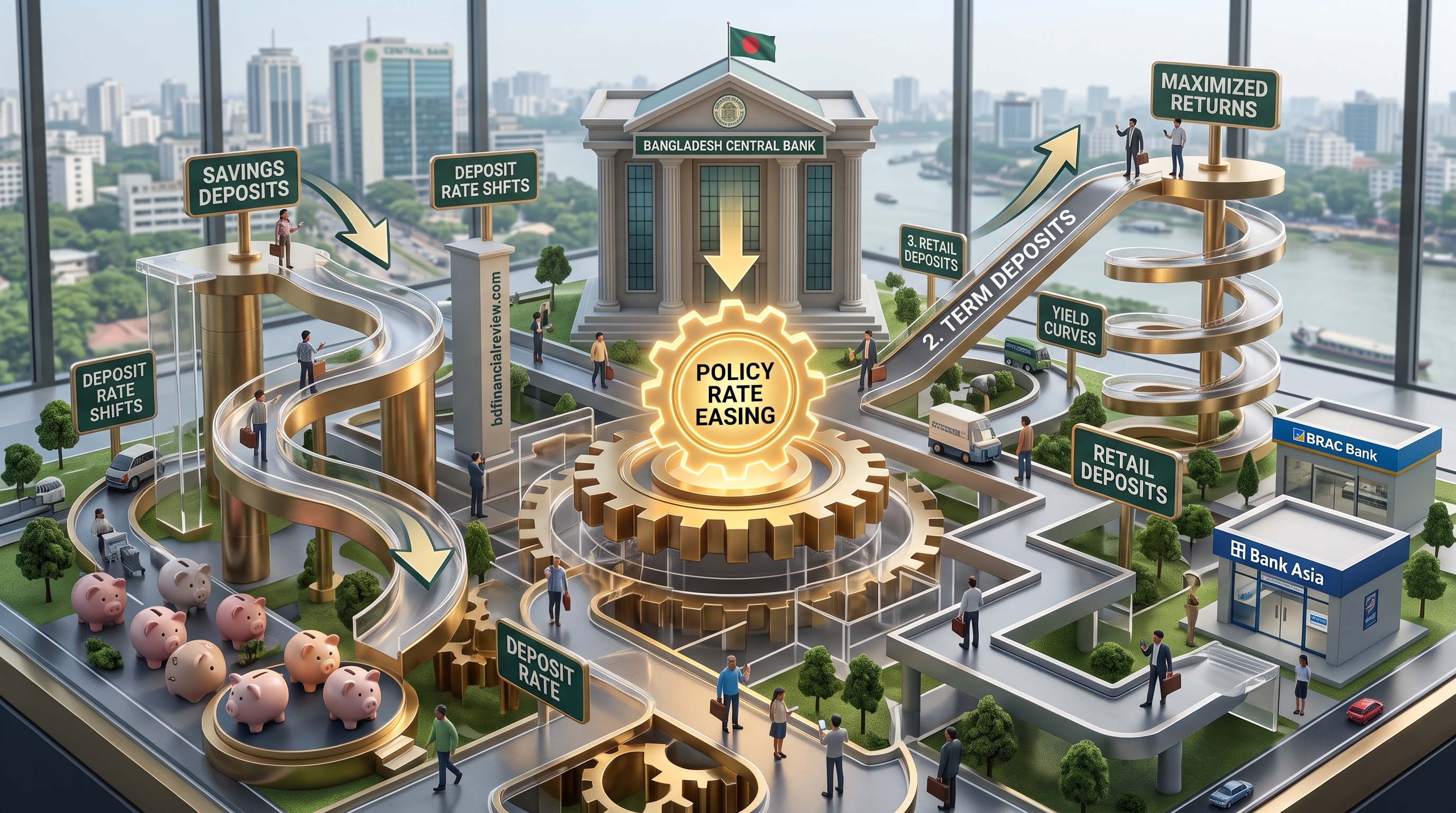
An in-depth analysis of Bangladesh Bank’s recent policy rate cut to 9.50 percent, its ripple effects across commercial bank Fixed Deposit Receipts (FDRs), and corporate treasury yield management in Dhaka.
Over the past twenty-four hours, financial circles across Motijheel and Gulshan have continued to assess the broader structural impact of Bangladesh Bank’s benchmark rate recalibration. Following the central bank's decision to lower the policy repo rate by 50 basis points down to 9.50 percent and reduce the Standing Lending Facility (SLF) to 11.00 percent, commercial lenders across the capital are gradually adjusting their internal deposit pricing schedules. This monetary easing marks a key transition from the prolonged twenty-one-month tightening cycle, signaling a regulatory push to reignite private sector credit while balancing interbank liquidity reserves.
For individual and corporate depositors evaluating Fixed Deposit Receipts (FDRs) across Dhaka’s commercial banks, this shift directly impacts net portfolio yields. Leading private commercial banks are currently offering multi-year FDR rates between 8.50 percent and 9.50 percent as they compete for stable, long-term retail funding. Conversely, state-owned commercial banks continue to maintain conservative deposit yields ranging from 6.50 percent to 7.50 percent, relying on sovereign backing and balance sheet safety rather than aggressive pricing to retain core balances. Financial analysts observe that as lower repo borrowing costs filter through the interbank system, commercial deposit yields will experience gradual downward pressure over the upcoming fiscal quarters.
In this evolving interest rate landscape, tax efficiency has become an essential component of yield optimization. Account holders maintaining active e-TIN registrations benefit from a reduced 10 percent Tax Deducted at Source (TDS) rate on interest income, compared to the 15 percent withholding rate applied to non-registered accounts. Financial advisors recommend employing an FDR laddering strategy dividing total investment capital across staggered 3-month, 6-month, and 1-year maturities to preserve liquid cash access while capturing peak yields before potential further rate cuts.
References
Free calculators
All calculatorsEMI & loan calculator
Monthly installment, total interest and a full repayment schedule. Compare two loan offers side by side.
Zakat calculator
Work out your nisab status and the 2.5% zakat due on cash, gold, silver, savings and business assets.
FDR & DPS maturity calculator
Maturity amount for a fixed deposit or monthly deposit scheme, after compounding and source tax.
Read next

Foreign Banks in Bangladesh See Profit Fall 38% in H1 While Treasury Bets Lift Domestic Rivals
Bangladesh's nine foreign commercial banks saw combined net profit fall 38% to Tk2,321 crore in the first half of 2026, hit by weak trade financing and energy shortages. At the same time, many domestic listed banks posted strong profit growth, driven almost entirely by investment income from government securities rather than new lending. Foreign banks still carry a far lower bad loan ratio and much stronger capital buffers than the sector average.

Sonali Bank Lends National Bank Tk7,000 Crore as a Deposit Rush Tests Bangladesh's Bailout Plan
State-owned Sonali Bank has lent Tk7,000 crore to National Bank, fully guaranteed by Bangladesh Bank, after about 7,500 withdrawal requests arrived at the troubled lender in three days. The loan is meant to help National Bank meet an October 15 deadline to resume full withdrawals. The bank still owes the central bank over Tk10,000 crore from an earlier unpaid loan, a reminder of how deep its problems, rooted in the Sikder family era, still run.

Bangladesh Bank Lets BRAC Bank's Biggest Shareholder Triple Its Board Seats
Bangladesh Bank has relaxed a board rule specifically for BRAC Bank, letting its largest shareholder appoint up to three representative directors instead of just one. The 12 October circular benefits BRAC, which an official said holds 46 percent of the bank's shares. It is the second such case-specific exemption this year, after a similar one for Trust Bank in March.