Record Remittance, Rising Reserves, Falling Stocks: Bangladesh's Economic Scorecard

Bangladesh is living through an unusual split-screen economy this August: remittances are up more than 25 percent year-on-year and foreign exchange reserves keep climbing, even as the Dhaka Stock Exchange has been sliding on gas-shortage fears and margin-rule rumours. Here is how the three biggest macro stories of the month connect, and what they mean for prices, jobs and your portfolio.
Start with the good news. Bangladeshi expatriates sent home $2.148 billion in the first 22 days of August 2026 alone, a 25.52 percent jump from the $1.711 billion recorded in the same window last year, an increase of $437 million. Zoom out to the full July-August stretch of the current fiscal year and the picture holds: $5.006 billion has arrived in the two months to August 22, up 19.5 percent from $4.188 billion a year earlier.
This matters well beyond the households directly receiving the money. Remittances are one of the two pillars alongside garment exports holding up Bangladesh's external accounts, and this year's surge is a direct contributor to the reserve build-up described below. Economists generally credit a combination of factors: a more stable, market-reflective exchange rate that has narrowed the gap with the informal hundi market, continued strong demand for Bangladeshi labour in the Gulf and Southeast Asia, and improved digital remittance channels that make formal transfers faster and cheaper than before.
Reserves Keep Climbing, Slowly and Steadily
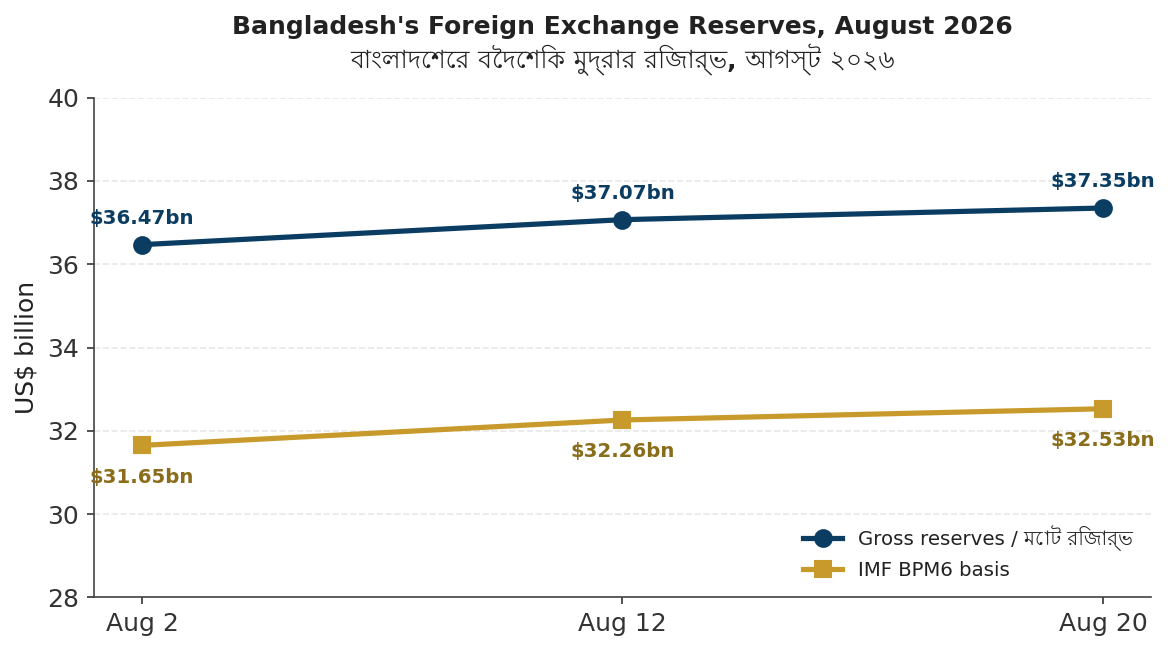
Bangladesh's foreign exchange reserves have risen through August: from $36.47 billion (gross) on August 2 to $37.07 billion on August 12 and $37.35 billion by August 20, according to Bangladesh Bank data. Measured on the more conservative IMF BPM6 basis, which excludes certain assets not readily usable for balance-of-payments purposes, reserves stood at $31.65 billion, $32.26 billion and $32.53 billion on those same dates respectively.
Bangladesh Bank's own strategy shift has helped: rather than continuing to sell dollars to defend the exchange rate as it did through the worst of the 2022-24 crisis, the central bank has spent the current fiscal year net-buying dollars from commercial banks through transparent auctions, purchasing roughly $4.3 billion so far. Combined with moderated import demand and the remittance surge, that has pushed reserves to their highest level since the post-pandemic peak, giving the central bank considerably more room to manage the taka without the kind of emergency dollar sales that marked 2023.
The Stock Market Tells a Different Story
The Dhaka Stock Exchange has not shared in the good mood. The benchmark DSEX index closed the week of August 22 at 5,786 points, down 97 points or 1.65 percent for the week, while the blue-chip DS30 index shed 30 points to close at 2,162. Daily average turnover fell 9.2 percent week-on-week to Tk905 crore, and market capitalisation lost roughly Tk3,800 crore in the sell-off, with 314 issues declining against just 52 advancing.
Two anxieties are doing the damage, according to market commentary. The first is a renewed gas-supply shortage, which investors fear will squeeze the earnings of energy-intensive listed companies in the months ahead. The second is a wave of rumours about stricter enforcement of margin-lending rules, which spooked leveraged retail investors even after regulators issued clarifications. The jute and paper-and-printing sectors bore the brunt of the decline, falling 4.6 percent and 4.5 percent respectively, while services and real estate were among the rare gainers, edging up 0.2 percent.
How These Three Stories Connect
It is tempting to read remittance strength, rising reserves and a falling stock market as contradictory signals, but they largely reflect different parts of the economy moving on different clocks. Remittances and reserves are backward-looking confirmations of an external sector that has genuinely stabilised after a rough few years. The stock market, by contrast, is a forward-looking bet on corporate earnings, and right now it is pricing in near-term operational risk from energy supply rather than any doubt about the broader macro turnaround.
If you receive remittances regularly, current exchange-rate stability makes it a reasonable time to route transfers through formal banking or mobile financial services channels rather than informal ones, since the rate gap has narrowed.
Equity investors should watch the gas-supply situation specifically, since it is the more company-specific and near-term risk driving the sell-off, rather than assuming the whole macro story has turned negative.
A stronger reserve position generally gives Bangladesh Bank more room to ease policy further without destabilising the taka, which is one reason this month's rate cut and the market sell-off are not necessarily in tension.
Watch DSE turnover figures as a sentiment gauge over the next few weeks ,a rebound in daily turnover alongside stabilising energy supply would signal the current dip is a correction rather than a trend.
What to Watch Next
The next major data points to watch are Bangladesh Bank's full-month remittance and reserve figures for August, expected in the first week of September, and any official communication on resolving the gas-supply constraints weighing on the stock market. If remittance growth holds above 20 percent year-on-year for a full month and reserves cross the $38 billion gross mark, expect renewed commentary about further monetary easing before the fiscal year is out.
References
Free calculators
All calculatorsEMI & loan calculator
Monthly installment, total interest and a full repayment schedule. Compare two loan offers side by side.
Zakat calculator
Work out your nisab status and the 2.5% zakat due on cash, gold, silver, savings and business assets.
FDR & DPS maturity calculator
Maturity amount for a fixed deposit or monthly deposit scheme, after compounding and source tax.
Read next

Bangladesh Pitches a Taka-Rufiyaa Swap to Untangle Remittances From the Maldives
Bangladesh Bank has proposed a currency cooperation plan to the Maldives Monetary Authority aimed at making it easier for more than 100,000 Bangladeshi workers in the Maldives to send money home. The move comes after formal remittances from the Maldives fell about 16.4% in FY2025-26 to roughly $118 million, even as the Bangladeshi workforce there has stayed above 100,000. The plan floats rufiyaa settlement through the Asian Clearing Union, taka denominated travel cards, and a possible bilateral currency swap, though all three still need regulatory approval from both sides.

Bangladesh Bank Raises Cash Dollar Limit for Travelers to $3,000 Per Transaction
Bangladesh Bank has raised the amount of cash US dollars a traveler can buy from a money changer in one transaction, from $2,000 to $3,000. The move follows last month's hike in the annual travel quota to $18,000. Here is how the limits have evolved since 2024, and what it means if you are planning a trip abroad.

A Stronger Taka Is Quietly Undercutting Bangladesh's Export Edge, Just as Shipments Hit a Record
Bangladesh's taka strengthened against the dollar in both July and August even as domestic inflation ran near 9 percent, pushing Bangladesh Bank's Real Effective Exchange Rate index up to 105.37, a level that signals the currency is now overvalued against its trading partners. An unnamed Bangladesh Bank official has said the central bank should consider letting the taka depreciate, warning that export earnings could suffer if it stays this strong. The timing is awkward: the warning lands just as Bangladesh's exports climbed 6.3 percent to 13.1 billion dollars in the first quarter of FY27, raising the question of how much of that recovery a persistently overvalued currency can allow to continue.