Remittances Hit a Three-Month High of 2.97 Billion Dollars in August, Here Is What It Means for Families Back Home
Expatriate Bangladeshis sent home 2.97 billion dollars in August, the strongest monthly total in three months and a 10.82 percent jump from a year earlier. A stronger exchange rate through formal banking channels and the government's 2.5 percent cash incentive are pulling more money through official routes, a shift that matters directly for the millions of households who depend on that money every month.
For the roughly one in three Bangladeshi households that depend, at least in part, on money sent home by a relative working abroad, the latest remittance numbers carry more weight than a simple economic statistic. Expatriates sent 2.97 billion dollars home in August, according to the latest data, marking the strongest single month in three months and a 10.82 percent increase over the 2.68 billion dollars recorded in August of last year. For families who count on that money for school fees, medical bills, or simply keeping the household running, an uptick like this translates directly into a little more breathing room.
The August figure caps off a gradual climb that has been building over the summer. Remittances came in at 2.82 billion dollars in June and rose to 2.86 billion dollars in July before reaching August's 2.97 billion dollars, a steady month-on-month improvement even though all three months technically remained below the 3 billion dollar mark that had become something of a new normal earlier in the year. Between December 2025 and May 2026, monthly remittances consistently topped 3 billion dollars, so June, July, and August represent a softer patch relative to that six-month run, even as August's total shows the softening may be starting to reverse.
Bankers who track these flows point to two main forces behind the recent strength. The first is a more favorable exchange rate available through formal banking channels, with the dollar trading at roughly Tk 122 to Tk 123 for remittance transactions in recent weeks. For an expatriate deciding whether to send money through a bank, a mobile financial service, or an informal hundi channel, the exchange rate on offer is often the single biggest factor in that choice, and a competitive formal rate closes the gap that used to push money through unofficial and untraceable routes. The second driver is the government's long-standing 2.5 percent cash incentive on remittances sent through formal channels, a subsidy that effectively boosts the taka value a family receives for every dollar sent, on top of whatever the prevailing exchange rate happens to be.
There is a quieter, less discussed factor at play too. Bankers note that dollar demand within the domestic economy has remained relatively subdued, a consequence of weak private-sector credit growth and reduced imports of capital machinery, the heavy equipment businesses buy when they are expanding factories or upgrading production lines. When fewer businesses are borrowing to invest and expand, fewer of them are also converting taka into dollars to pay for imported equipment, which leaves banks holding more comfortable dollar liquidity positions. That, in turn, gives banks room to offer more competitive exchange rates to remittance senders without straining their own dollar reserves, creating something of a virtuous cycle for the people sending money home, even though the underlying reason, sluggish private investment, is not itself a particularly encouraging sign for the broader economy.
For a household on the receiving end, the practical implications are fairly direct. A family that regularly receives, say, 500 dollars a month from a relative working in the Gulf or Malaysia is now getting several thousand taka more each month than they would have at the exchange rates and incentive structures of a year ago, simply from the combination of a stronger formal rate and the cash incentive. That difference can matter enormously for lower and middle income households where remittance income covers a meaningful share of monthly expenses, whether that is a child's tuition, a parent's medication, or a small loan repayment.
Country of origin also shapes how these flows behave, even though month-to-month breakdowns by source country were not published alongside the August total. Historically, the Gulf states of Saudi Arabia, the United Arab Emirates, and Qatar together with Malaysia and the United States have accounted for the largest shares of remittances into Bangladesh, reflecting where the bulk of the country's roughly one crore expatriate workers are employed. Workers in the Gulf tend to send smaller, more frequent amounts tied to monthly salary cycles, while those in North America and Europe often send larger sums less frequently, patterns that together shape the somewhat lumpy month-to-month totals the country sees rather than a perfectly smooth upward line.
It is also worth understanding why the formal channel matters so much beyond the immediate exchange rate benefit. Money sent through a bank or a licensed mobile financial service like bKash or Nagad is tracked, contributes to the country's official foreign exchange reserves, and gives the sender and recipient a documented financial history that can matter later for things like loan applications or visa processes. Money sent through informal hundi networks, by contrast, might occasionally offer a marginally better rate in some circumstances, but it does nothing for the country's reserves, carries real risk of fraud or non-delivery, and leaves no paper trail that could benefit the family down the line. The steady narrowing of the rate gap between formal and informal channels over the past year is precisely why more money appears to be flowing through banks and licensed operators rather than around them.
The timing of this remittance strength also connects to a broader story playing out in the banking sector. With more dollars flowing in through formal channels, Bangladesh Bank recently resumed direct dollar purchases from banks after a three-month pause, buying 50 million dollars at Tk 122.75 per dollar in early September, its first such purchase since May. That move by the central bank is itself a signal of confidence that the foreign exchange market has enough supply to support both remittance-driven inflows and the central bank's own reserve-building needs, a dynamic that traces directly back to households and expatriate workers choosing formal channels over informal ones in growing numbers.
Looking ahead, families who rely on remittance income should not necessarily expect the August pace to continue in a straight line, since remittance flows tend to be seasonal, with notable spikes around religious holidays like Eid when expatriates traditionally send extra money home for celebrations, and quieter stretches in between. What is more durable, according to bankers, is the underlying shift toward formal channels driven by competitive exchange rates and the cash incentive, a trend that, if it holds, should continue to benefit recipient households even during the seasonally quieter months, and gives ordinary families one less thing to worry about in an economy where plenty of other costs have been moving in the wrong direction. Families expecting money from abroad can generally get a slightly better rate, and near-instant crediting, by having the sender use a bank's official app or a licensed mobile financial service rather than an informal agent, a small habit change that, multiplied across a year of monthly transfers, can add up to a noticeable sum.
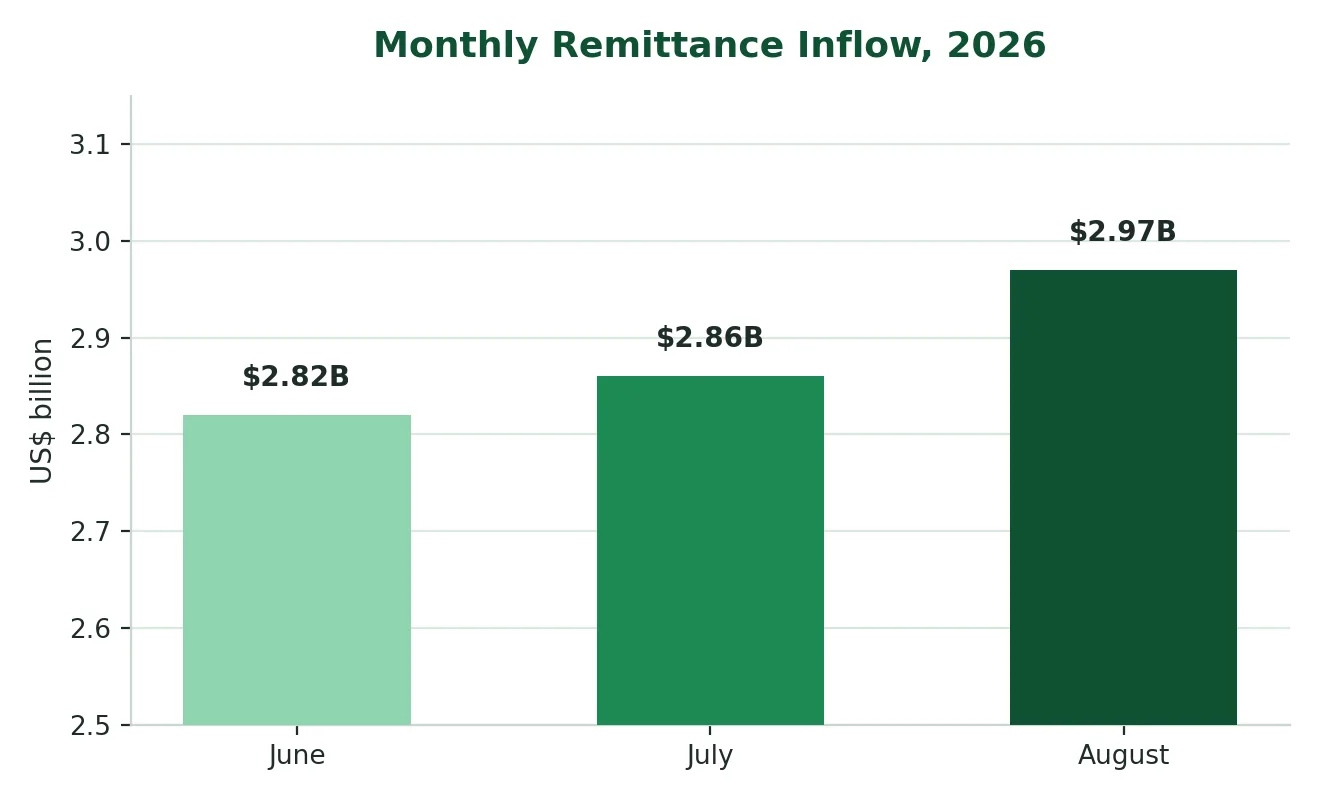
Monthly Remittance Inflow, 2026 (US$ billion)
References
Free calculators
All calculatorsEMI & loan calculator
Monthly installment, total interest and a full repayment schedule. Compare two loan offers side by side.
Zakat calculator
Work out your nisab status and the 2.5% zakat due on cash, gold, silver, savings and business assets.
FDR & DPS maturity calculator
Maturity amount for a fixed deposit or monthly deposit scheme, after compounding and source tax.
Read next

Why Your LPG Cylinder Still Costs More Than the New Official Price
Bangladesh's energy regulator raised the price of a 12 kilogram LPG cylinder to 1,837 taka this month, yet most households are still paying far more at the shop. A public hearing called for October 29, the first in five years, will decide whether the official price catches up with reality or the shortage does.

TCB's Family Card List Shrinks to 80 Lakh as It Chases a Tk8,000 Crore Budget
The Trading Corporation of Bangladesh has verified nearly 80 lakh genuine Family Card beneficiaries, far short of its original one-crore target, after weeding out duplicate and multiple claims. Officials are framing the smaller, cleaner list as the foundation for an ambitious Tk8,000 crore FY27 procurement plan and a longer-term push toward ending subsidies altogether. About 73.7 lakh Smart Family Cards are active, with the rest expected before the next Eid-ul-Fitr.

Bangladesh Bank's First Rulebook for Islamic Credit Cards Bans Hidden Profit and Growing Late Fees
Bangladesh Bank has issued its first comprehensive guidelines for Islamic credit cards, replacing interest based charges with a fixed service fee and turning late payment penalties into a pre agreed charity donation that cannot escalate. Here is how an Islamic card now differs from a conventional one, and what the new fraud protection and cooling off rules mean if you carry one.